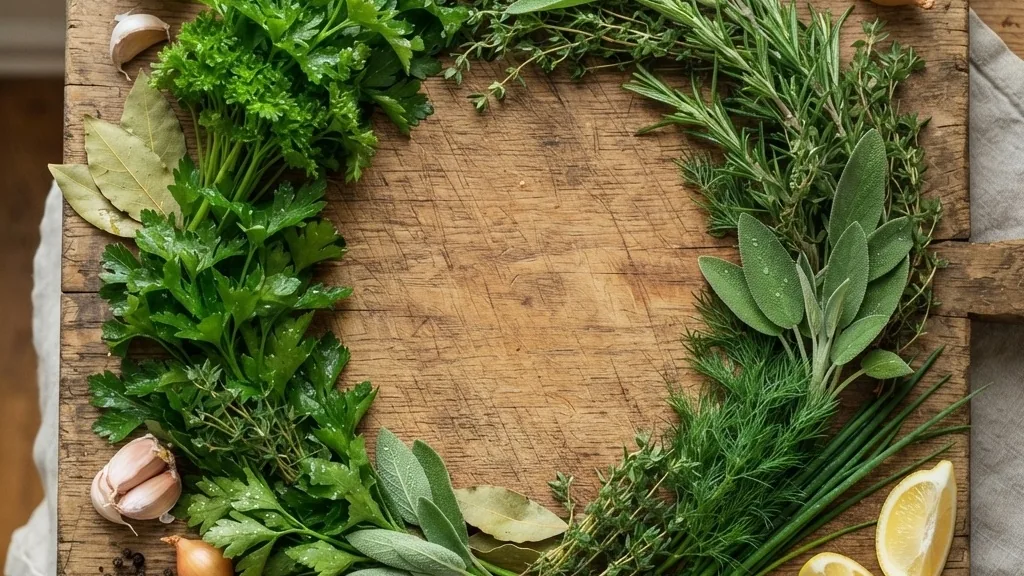
Fresh herbs for soup split into two camps that behave nothing alike in the pot: woody stems like thyme and rosemary can ride out a long simmer, while tender leaves like basil, parsley, and chives turn dull and grassy if they hit boiling broth too early. Knowing which fresh herbs for soup go in early and which go in at the end is the difference between a pot that tastes bright and one that tastes flat.
Get it right and a plain vegetable pot tastes like it came from a much better kitchen. Get it wrong and you paid for a bunch of parsley that added nothing. Most guides online treat every herb the same and skip the parts that matter most: when each one goes in, how much to use, how to buy a bunch that still has flavor left in it, and what to do with the half-bunch wilting in your fridge. That same timing split decides whether a slow cooker ham and lentil soup slow cooker tastes bright or muddy, and it is the same split that decides whether a quick weeknight broth tastes homemade or just tastes like water with vegetables floating in it.
None of that is complicated once you see the pattern. Woody, thin-leaved herbs with tough stems carry oils that survive heat for an hour or more. Soft, broad-leaved herbs carry oils that cook off in minutes. Once you sort any herb into one of those two piles, you already know roughly when it should hit the pot, and the rest of this guide fills in the exact quantities, the swaps, and the storage tricks that make the difference stick.
Quick answer: the best fresh herbs for soup are the ones added at the right moment. Woody herbs (thyme, rosemary, bay leaf, sage) go in early and simmer for the whole cook, then get fished out. Tender herbs (parsley, chives, basil, dill, cilantro) go in during the last few minutes or off the heat, so their oils stay bright. When you are swapping in dried, use more fresh than dried by volume. Stash leftover bunches by freezing chopped leaves in ice cube trays topped with water, then drop a cube straight into the pot when soup night comes around.
Woody herbs go in early, tender herbs at the finish
Add woody herbs early and tender herbs late. Thyme, rosemary, bay leaf, and sage carry tough stems and oils that survive an hour in simmering broth, so they belong in near the start. Parsley, chives, basil, dill, and cilantro are delicate, and long heat cooks the flavor and the green color straight out of them. The reason is simple chemistry: flavor lives in volatile oils that fade with heat and time. A rosemary sprig releases its oils slowly across a long cook, which is why one stem can carry a whole pot. A handful of basil dumped in at the start has nothing left by the time the soup is done.
Picture two versions of the same chicken soup. In the first, a thyme sprig and a bay leaf go in with the raw chicken and simmer alongside it as the chicken cooks through. In the second, someone stirs in fresh dill at that same point in the simmer instead of at the end. By the time the soup is served, the dill has turned a dull olive color and tastes bitter rather than bright. Same pot, same herb family logic, opposite result, because one herb was built to take the heat and the other was not.
| Type | Examples | When to add | Remove before serving? |
|---|---|---|---|
| Woody | thyme, rosemary, bay leaf, sage | start of the simmer | Yes, pull whole sprigs and bay leaves |
| Tender | parsley, chives, basil, dill, cilantro | last few minutes or off heat | No, chopped and left in |
Woody sprigs are easy to fish out. Drop whole thyme and rosemary stems and bay leaves into the pot, then pull them before serving. The leaves fall off the woody stems as they soften, and the bare stems and bay come out clean. If you forget to remove a bay leaf, it is not dangerous, just tough and unpleasant to bite into, so it is worth a habit of counting them in and counting them back out.
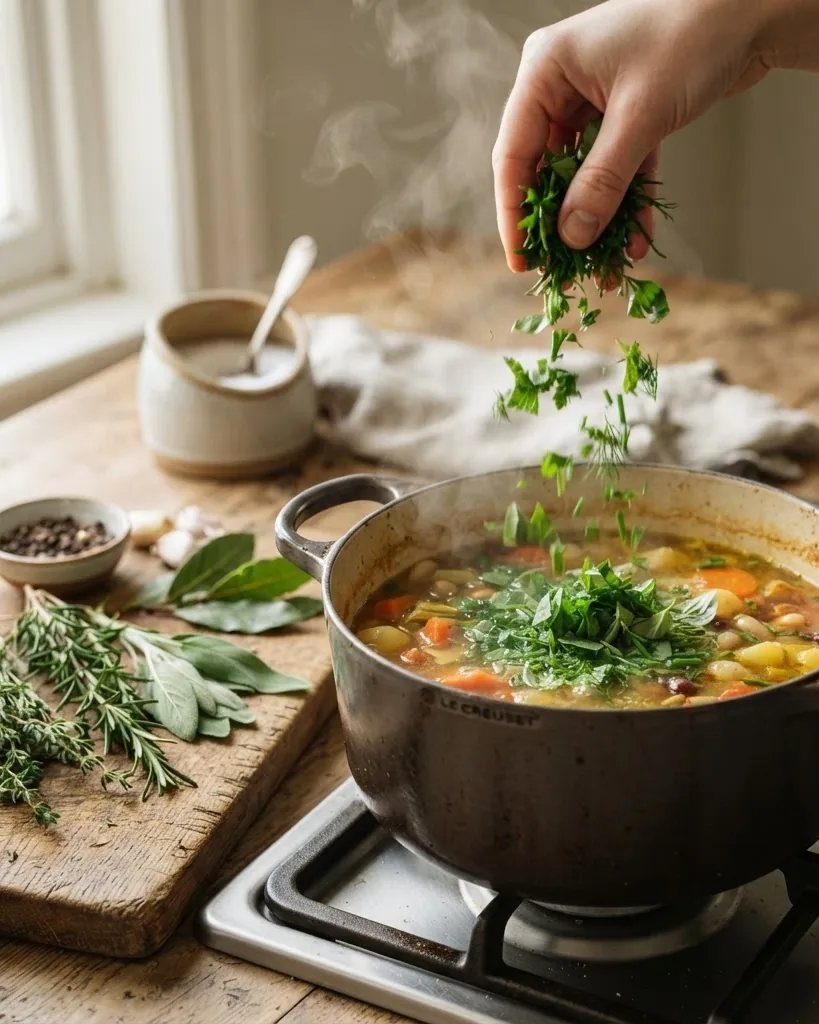
Tender herbs want a different touch. Chop or bruise them first, because crushing the leaves breaks the cells and lets the oils escape. A rough chop on parsley or cilantro, a chiffonade on basil, or a quick bruise with the flat of a knife on mint all wake the flavor before it hits the bowl. Stir them in during the last two or three minutes, or after you kill the heat.
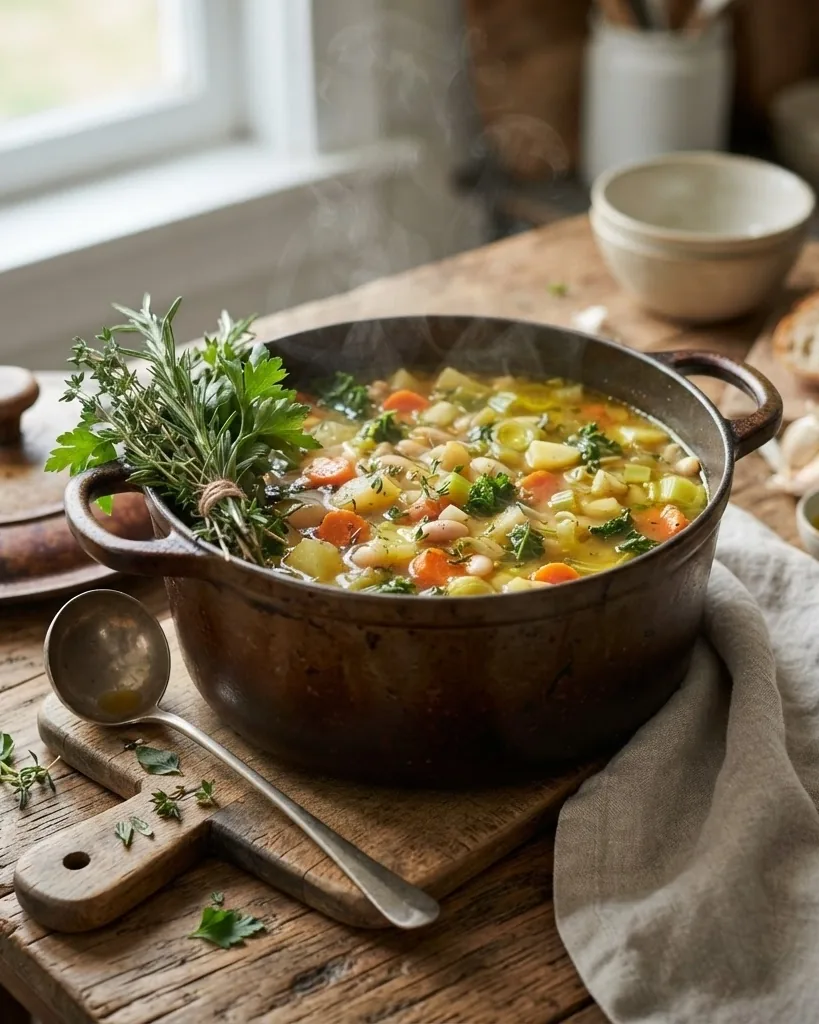
Some cooks tie the woody ones into a bouquet garni, a small bundle of thyme, bay, and parsley stems bound with kitchen string. It flavors the broth and lifts out in a single pull, which is faster than hunting for loose sprigs in a full pot with a slotted spoon. A bouquet garni also keeps small woody leaves from scattering through the broth, which matters if you want a clear, restaurant-style soup rather than a rustic one. If you grow your own, the University of Minnesota Extension notes that herbs hold the most oil when cut in mid-morning, once the dew has dried, so that is the window that gives home growers the strongest flavor.
How much fresh herb to use per pot
There is no single correct amount, since herb strength varies by season, plant, and how finely you chop, but a workable starting point is about one to two tablespoons of chopped fresh tender herb, or two to three sprigs of a woody herb, per quart of finished soup. From there, taste and adjust rather than following a number blindly.
Strong herbs like sage and rosemary punish a heavy hand fast, so start with one sprig per pot and add a second only if the broth still tastes flat once everything else is in. Milder herbs like parsley and dill are far more forgiving, and a generous handful rarely goes wrong, since they read as fresh rather than medicinal even in larger quantities.
Bigger batches scale the same way in proportion, so if you double a soup recipe from one pot to two, double the herb quantity as well rather than assuming the same handful will carry twice the broth. The mistake most home cooks make is under-seasoning with herbs in a big batch, since a quantity that seemed generous in a small pot disappears once it is stretched across four times the liquid.
The fresh-to-dried swap when the garden is bare
When you are out of fresh, dried herbs stand in fine, but the ratio is not one-to-one. The University of Minnesota Extension puts one tablespoon of fresh chopped herbs equal to one teaspoon of crumbled dried leaves, or about a quarter teaspoon of ground dried herb. Dried is more concentrated, so a heavy hand turns a pot bitter. Since a tablespoon holds three teaspoons, that lines up to roughly a three-to-one swap by volume.
Worked example: a recipe calls for two tablespoons of fresh thyme leaves. Using the ratio above, that becomes about two teaspoons of crumbled dried thyme, or roughly half a teaspoon if you only have ground thyme in the jar. Start at the lower end of that range and taste before adding more, since dried herbs vary in strength depending on how long they have sat on the shelf.
Timing flips too. Dried herbs need time to rehydrate and bloom, so add them early with the woody-herb crowd rather than at the finish. That is why a long-simmered bean pot handles dried thyme or oregano well, even though the same dried herb stirred in at the last minute would taste flat and papery instead of rounded.
Dried does not last forever, either. The same extension guidance gives dried herbs about 3 months of good aroma and color in a cupboard, stretching to as much as 1 year in the fridge or freezer if you keep them airtight and out of light and heat. If your dried oregano smells like dust, it is doing nothing for your soup, and no amount of extra spoonfuls will bring back an aroma that has already faded. Fresh still wins for any bright finishing note, where the whole point is a raw, green lift right before serving.
Matching fresh herbs for soup to chicken, tomato, and lentil pots
Different pots want different herbs, and the pairing follows the base flavor. Chicken and light broths take clean herbs like thyme, dill, and parsley. Tomato and tomato-vegetable pots love basil and oregano. Bean, lentil, and split pea soups carry the heavier, resinous herbs, sage and rosemary, without getting lost. The trick is layering the woody ones in early for depth and the tender ones at the end for lift.
Here is the short version, herb by pot:
- Chicken noodle: thyme and bay early, chopped parsley and dill at the end. A little lemon zest alongside the dill sharpens the whole bowl.
- Tomato: a bay leaf early, torn basil and a little oregano off the heat. Basil bruises fast once cut, so tear it right before serving, not an hour ahead.
- Lentil or split pea: sage and thyme early, parsley to finish. Sage is strong, so one leaf or a single small sprig is plenty for a full pot.
- Minestrone or mixed vegetable: rosemary and bay early, basil and parsley late. A rind of parmesan simmered alongside the rosemary rounds out the herb flavor.
- Potato leek: thyme and bay in the pot, raw chives on top. The chives should go on the bowl, not into the pot, since heat kills their sharp bite almost instantly.
- Seafood chowder: thyme and bay early, dill and parsley at the finish. Dill and seafood are a classic pairing for a reason, the anise-like note cuts through the richness of cream.
- Beef and barley: rosemary and bay for depth, parsley to brighten. This is a pot where dried thyme added early also works well if fresh is not on hand.
Cilantro is its own case. It fades fast and bruises easily, so it never simmers. Stir it in raw at the very end, the move that makes a chicken tortilla soup or a black bean pot sing. If someone at the table tastes soap, keep cilantro on the side and pass parsley instead, since the compound that reads as soapy to some people is a genetic quirk that no amount of chopping or cooking technique will fix.
The heavier grain-and-bean soups reward this layering the most, because they cook long enough to flatten out. A hearty vegan beef and barley soup tastes one-dimensional with dried herbs alone, then comes alive when you add a fistful of chopped parsley at the table. Match the herb weight to the soup weight and you rarely go wrong.
Buying fresh herbs that still have flavor left
A wilted bunch from the back of the produce case will not save any soup, no matter how carefully you time it. Look for leaves that are perky and deeply colored, not yellowing, spotted, or slimy at the stem ends, since those are the first signs a bunch is past its useful life. A quick smell test also works: a strong, distinct aroma when you rub a leaf between your fingers means the oils are still there, and a faint or musty smell means most of the flavor is already gone.
For parsley specifically, flat-leaf, sometimes labeled Italian parsley, has a stronger flavor and chops more cleanly than curly parsley, which makes it the better default for cooking into soup. Curly parsley still works fine as a garnish where its texture stands out more than its taste. For woody herbs, avoid bunches where the stems have gone soft or brown at the base, since that is usually a sign the sprigs have been sitting too long since harvest.
Freezing herbs in ice cubes for winter soup
The best way to keep fresh herbs for months of soup is to freeze them in ice cube trays. Chop washed herbs, pack them into the tray wells, top with water, freeze solid, then move the cubes to an airtight container. Drop one straight into a simmering pot with no thawing. Frozen herbs go soft when they defrost, so they cook beautifully but do not work as a raw garnish.
Penn State Extension confirms the practical part most cooks worry about: frozen herbs go into a dish in the same amount you would use fresh, so you are not guessing at a new ratio. You can read the full method in Penn State Extension’s guidance on freezing herbs, which walks through both blanched and unblanched routes.
A couple of variations save even more work:
- Oil cubes: pack the wells with herbs and cover with olive oil instead of water. These are handy for sauteeing the base of a soup, since the oil carries the flavor into the pot.
- Portion by pot: a standard tray well holds about one to two tablespoons, so a single cube usually flavors a family-size pot.
Freeze the tender herbs this way, not the woody ones. Thyme, rosemary, and sage keep their punch dried, while basil, parsley, cilantro, and dill lose their character in a jar. Those are the ones worth freezing.
Label every container with the herb name and the date it went into the freezer, since chopped frozen herbs in water all look roughly the same shade of green once they are cubed, and a mystery cube is a bad surprise in a delicate broth. Keep separate containers for separate herbs rather than mixing a general blend, since that gives you the flexibility to pick exactly the right herb for whatever soup you are making that night rather than committing every pot to the same mixture.
Drying your own herbs at home
If a bunch is more than you can use fresh or freeze before it turns, air-drying is the low-effort option. Tie small bundles of woody herbs like thyme, rosemary, or sage by the stems and hang them upside down in a warm, dry, well-ventilated spot out of direct sun until the leaves crumble easily between your fingers, which usually takes one to two weeks depending on humidity. A low oven or a food dehydrator on its lowest setting speeds this up for a busier kitchen, though it takes closer watching so the leaves do not scorch.
Tender herbs like basil, parsley, and dill dry less predictably at home and tend to lose color and aroma faster than woody herbs, so freezing is usually the better route for those. Once any herb is fully dry and crumbly, strip the leaves from the stems, store them in a small airtight jar away from light and heat, and use the same fresh-to-dried swap ratio described above when you cook with them. Homemade dried herbs follow the same shelf life window as store-bought: roughly 3 months for peak aroma and color, up to a year if kept cold and sealed.

Why parsley earns a second bunch
Parsley pulls double duty in a soup pot: flavor and nutrition. Beyond the fresh, grassy lift it gives at the table, it is one of the most vitamin-K-dense foods in the government database. The USDA FoodData Central figure for fresh parsley lands at roughly 1,640 micrograms of vitamin K per 100 grams, among the highest concentrations on record. Flat-leaf (Italian) parsley has more flavor and chops cleaner than curly, so it is the better pick for cooking. You can check the full nutrient breakdown at the USDA FoodData Central entry for fresh parsley. Keep the stems too; they are tender enough to chop into the pot, and they carry plenty of that same flavor.
Because vitamin K plays a role in blood clotting, this is worth knowing if you take blood-thinning medication, since a sudden large increase in vitamin K intake can interact with certain prescriptions. That is not a reason to avoid parsley in ordinary cooking amounts, but it is worth mentioning to a doctor if you plan to eat unusually large quantities of it regularly rather than the modest garnish-sized amounts a typical bowl of soup carries.
Infused herb oils and the botulism rule cooks skip
Home-infused herb oils look harmless and are the one place fresh herbs turn dangerous. Fresh herbs are low-acid and carry Clostridium botulinum spores, and oil creates the airless, low-acid setting where those spores can produce botulism toxin. A jar of garlic-and-basil oil left at room temperature is a classic culprit. This is the reason to follow a validated method rather than improvising a pretty bottle for the counter.
Penn State Extension gives a home approach that manages the risk: submerge one part fresh herbs in ten parts of a 3 percent citric acid solution for at least 24 hours before you make the oil, a process validated only for garlic, basil, oregano, and rosemary. The full protocol is in Penn State Extension’s method for making infused oils safely, and it is worth reading before you infuse anything, including how long the finished oil should be kept and how it should be stored once it is done.
Several federal bodies sit behind this guidance. The U.S. Food and Drug Administration sets the food-safety rules for retail and packaged foods. The Centers for Disease Control and Prevention tracks foodborne illness, including botulism cases. FoodSafety.gov is the government clearinghouse for that public guidance, and the U.S. Department of Agriculture, through its Food Safety and Inspection Service, oversees the meat, poultry, and egg products that end up in most soup stocks. For everyday cooking you can sidestep the whole question: stir fresh herbs into the soup itself, where the water and short cook time keep things safe, and skip the raw oil infusion entirely.
Washing, drying, and keeping a bunch alive all week
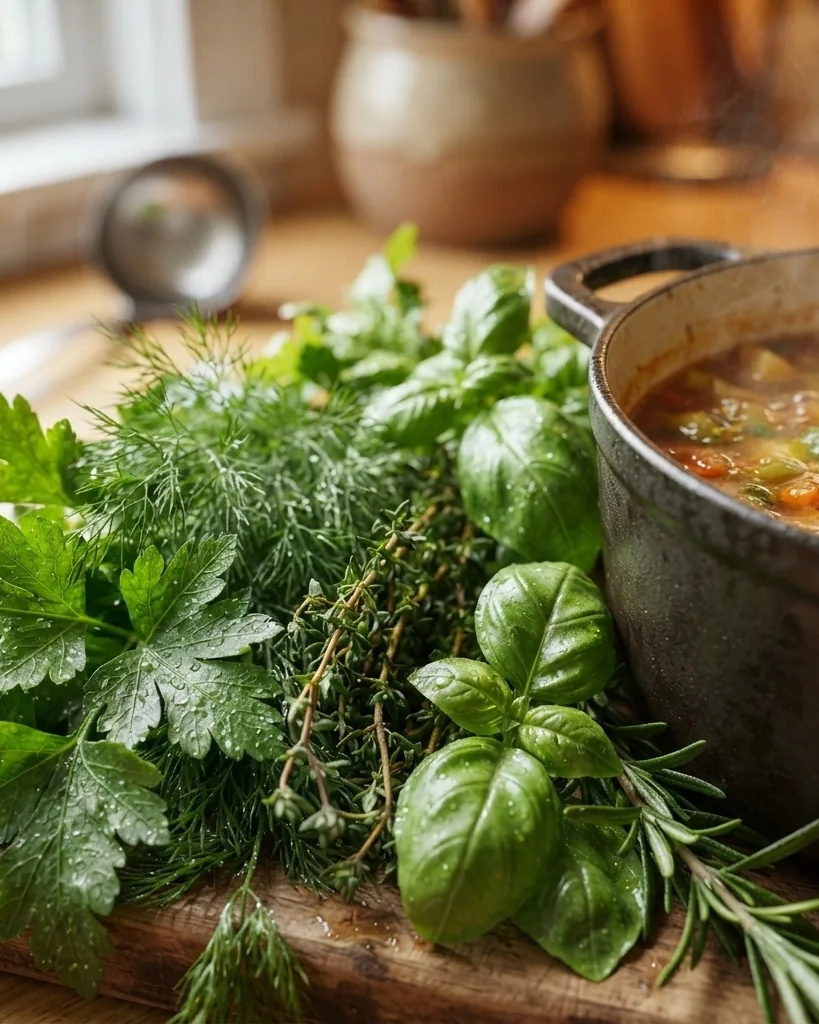
Grit is the enemy, so wash herbs well and dry them fully before they go anywhere near a pot. Swish the leaves in a bowl of cold water, let the sand settle, then lift them out and spin or pat them dry, since wet herbs bruise and rot fast. University of Florida IFAS EDIS, in its “Cooking with Fresh Herbs” guidance, covers this handling along with washing and short-term storage. To keep a bunch alive for the week, trim the stem ends, stand them like flowers in a glass with a little water, loosely tent the tops with a bag, and refrigerate. Parsley, cilantro, and dill hold especially well this way.
Basil is the exception worth remembering. Cold refrigerator temperatures turn its leaves black and mushy within a day or two, so basil prefers the same glass-of-water treatment but left on the counter at room temperature instead of in the fridge. Rosemary, thyme, and sage keep the longest of any fresh herb, often two weeks or more, when wrapped loosely in a damp paper towel and stored in the crisper drawer of the fridge.
Common mistakes with fresh herbs in soup
A short list of habits ruins more pots of soup than any single wrong herb choice, so it is worth checking your own routine against these before the next batch.
- Adding tender herbs too early: basil, parsley, dill, and cilantro dumped in at the start turn bitter and grey by the time the soup is done, instead of bright at the finish.
- Swapping dried and fresh one-to-one: dried is roughly three times more concentrated by volume, so an even swap almost always overshoots and turns the broth bitter or medicinal.
- Forgetting to remove woody stems and bay leaves: a mouthful of stiff thyme stem or a whole bay leaf is unpleasant and occasionally a choking hazard for young children.
- Buying wilted herbs on sale: a discounted bunch with yellowing leaves has already lost most of its aroma, and no amount of extra quantity makes up for oils that have already evaporated.
- Storing basil in the fridge: cold turns basil black within a day or two, so it belongs on the counter in a glass of water, not in the crisper drawer with everything else.
- Leaving homemade infused herb oil at room temperature: skipping the citric acid step or the refrigeration step turns a flavorful oil into a genuine botulism risk, not just a quality issue.
FAQ
When do you add fresh herbs to soup?
It depends on the herb. Woody herbs like thyme, rosemary, bay leaf, and sage go in at the start of the simmer and cook the whole time. Tender herbs like parsley, chives, basil, dill, and cilantro go in during the last few minutes or after you turn off the heat, so their oils and color survive.
Can you freeze fresh herbs for soup?
Yes, and it is one of the best ways to avoid waste. Chop washed herbs, pack them into ice cube tray wells, cover with water, and freeze. Store the cubes in an airtight container and drop one into a simmering pot. Frozen herbs turn soft when thawed, so they cook well but do not work as a raw garnish.
What is the fresh-to-dried herb ratio?
About three to one by volume. The University of Minnesota Extension puts one tablespoon of fresh chopped herbs equal to one teaspoon of crumbled dried leaves, or a quarter teaspoon of ground dried herb. A tablespoon holds three teaspoons, so you use roughly three times more fresh than dried. Add dried early, since it needs time to soften.
Which fresh herbs are best for chicken soup?
Thyme is the backbone, added early so it can simmer with the broth and bones. Bay leaf works alongside it. At the end, stir in chopped parsley and dill for a fresh lift, and chives if you want a mild onion note. Pull the thyme stems and bay leaf before serving.
Do you take the herb stems out of soup?
Take out woody stems, leave tender ones. Whole thyme sprigs, rosemary stems, and bay leaves are tough and go in and come out in one piece. Tender herbs like parsley and cilantro are chopped, stems and all in many cases, and stay in the bowl. Bay leaves should always be removed.
Can you use dried herbs instead of fresh in soup?
Yes, with two changes: use less by volume, roughly one-third the amount of fresh called for, and add it earlier in the cook so it has time to rehydrate and release its flavor rather than tasting flat and dusty.
How do you keep basil from turning black in soup?
Add it at the very last minute or stir it in after the heat is off, since prolonged heat and prolonged contact with acidic tomato bases both darken basil quickly. Tearing rather than cutting with a knife also slows the browning slightly compared to a fine chop.
What soups show off fresh herbs best?
Brothy and creamy pots both work. A creamy vegan gnocchi soup carries basil and parsley beautifully, while a clear chicken or vegetable broth lets thyme and dill stand out. Bean and lentil soups take well to sage and rosemary early, then a shower of parsley at the table to wake everything up.