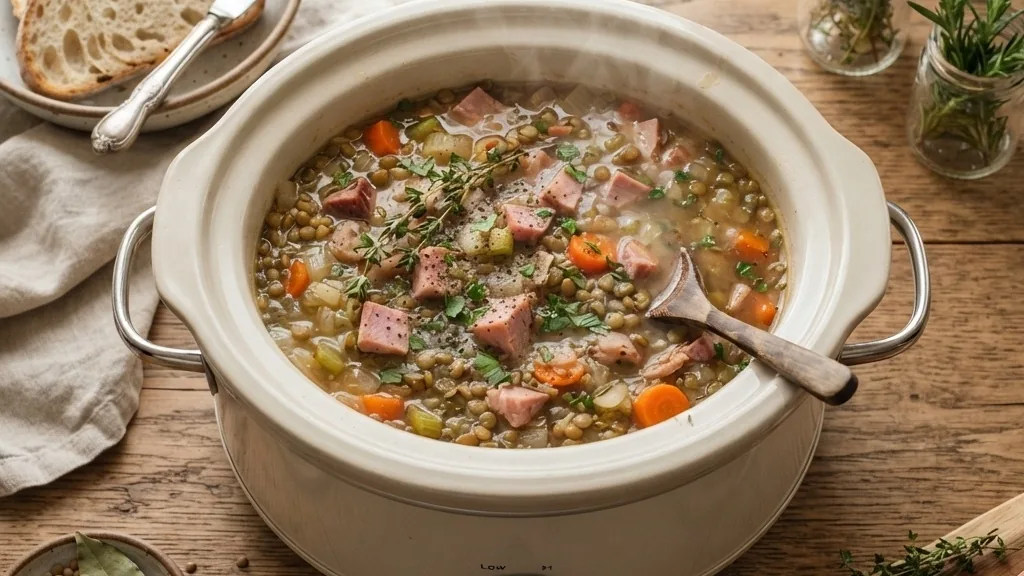
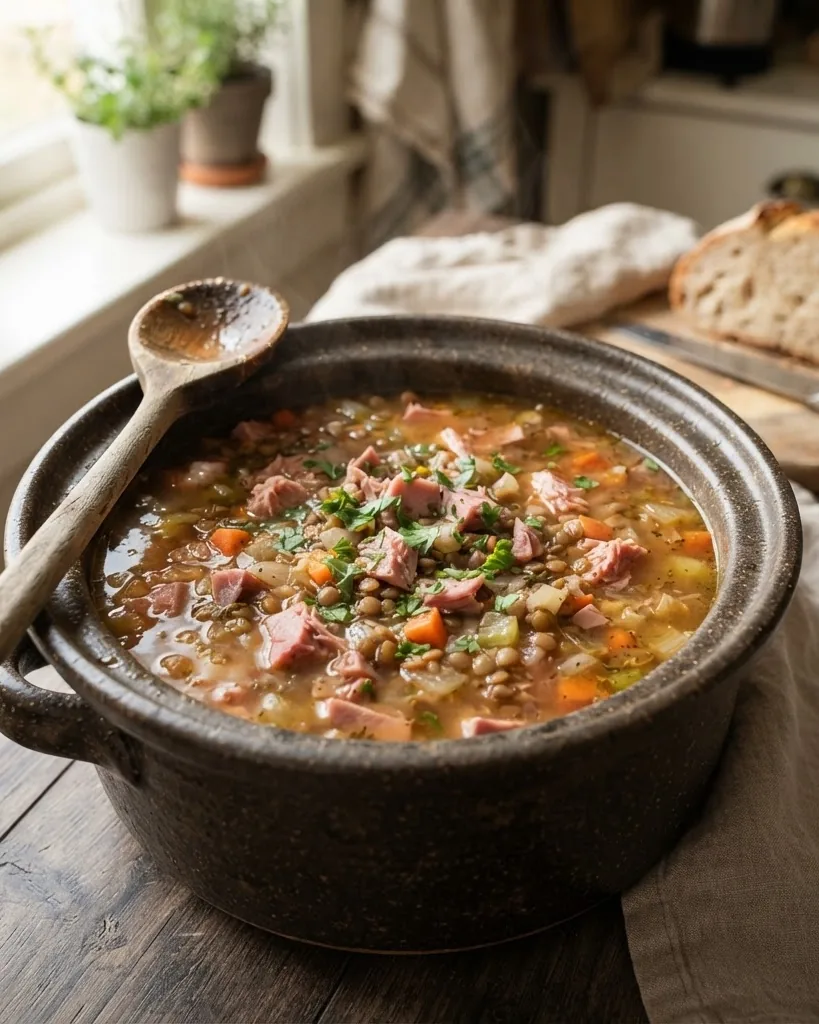
Ham and lentil soup slow cooker recipes fail on one decision more than any other: the lentil you drop in the crock. Grab red lentils and you get orange sludge by hour four. Grab green or brown and they hold their shape through a long, gentle cook. The ham you choose matters almost as much, because a smoked bone, a hunk of leftover spiral ham, and a bag of diced ham each behave differently on salt, flavor, and moisture. Get those two calls right and the rest is timing.
The three recipes ranking above this one all cook a decent pot. Betty Crocker leans on a ham shank and a clean dump method. Living Lou builds a French mirepoix base and finishes with cider vinegar. Julia’s Album covers slow cooker, stovetop, and Instant Pot in one place. What none of them do is put food safety, a real lentil-and-ham decision matrix, and sourced nutrition in the same guide. That gap is the whole point of what follows.
Quick answer up front: for ham and lentil soup slow cooker done right, use green or brown lentils, never red. Add ham for flavor, salt only at the very end because cured meat and broth are already salty, and stir in spinach plus a splash of cider vinegar in the last few minutes. Reheat any leftovers to 165 degrees Fahrenheit.
Green Or Brown Lentils Hold, Red Lentils Turn To Mush
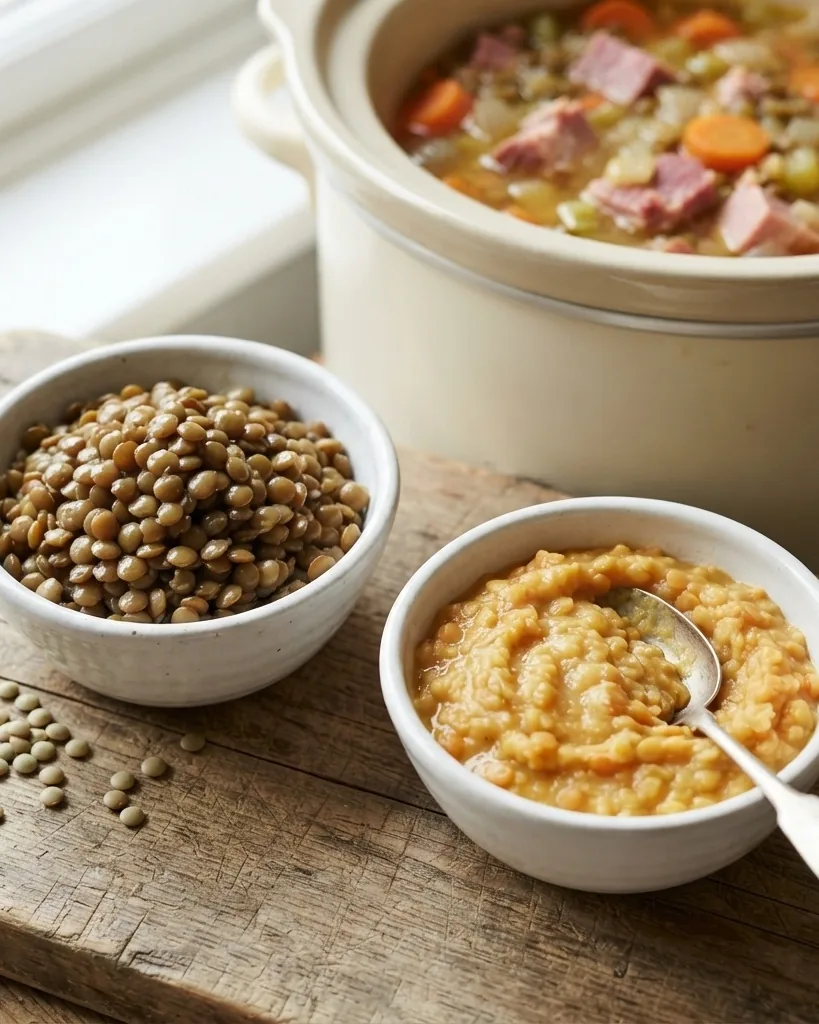
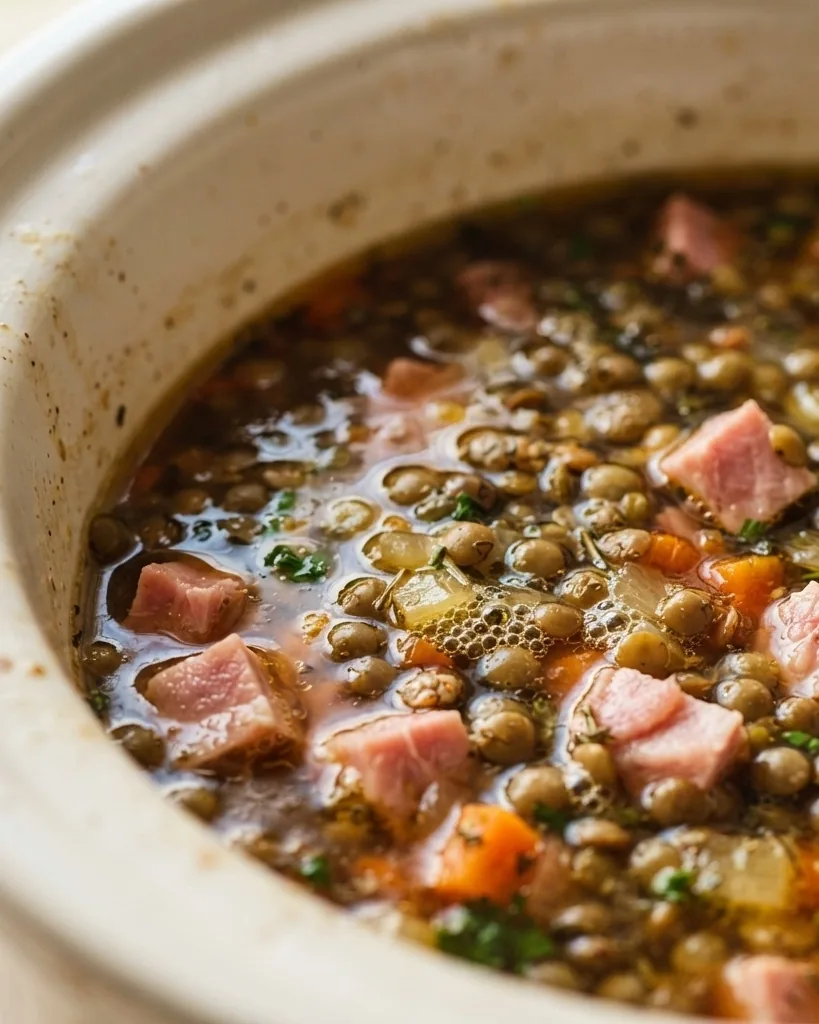
Green and brown lentils are the only safe choice for a long slow-cooker soup, because they keep a distinct bite through hours of heat while red and yellow lentils break down into a thick puree. This single decision separates a soup with texture from a pot of gritty paste. Black beluga lentils hold their shape best of all if you can find them. The reason is structural: red and yellow lentils are usually split and skinless, so they cook fast and collapse, which is exactly what you want in dal and exactly what you do not want here. Julia’s Album confirms the same split, noting green and brown lentils hold shape while red lentils turn mushy.
- Green or brown lentils: hold shape, best all-purpose pick, no presoak needed.
- Black beluga lentils: hold shape best, firmer bite, slightly pricier.
- Red or yellow lentils: disintegrate fast, use only if you want a pureed soup.
You do not need to presoak or precook green or brown lentils. They go in dry, straight from the bag, which is the whole appeal of a dump-and-go pot. Red lentils are the exception, and not because they need soaking but because they need watching, since they can dissolve in under two hours on High. If a recipe promises a brothy soup with visible lentils, red is the wrong tool.
One habit worth building: rinse and pick over dried lentils before they hit the crock. A quick rinse clears dust, and a glance across the pile catches the occasional small stone that slips through packing. It costs thirty seconds and saves a cracked tooth.
Ham Bone, Leftover Spiral, Or Diced: Three Very Different Pots
The format of your ham changes flavor, salt level, and texture more than any seasoning you add. A smoked ham bone or shank gives the deepest, roundest flavor as collagen and marrow melt into the broth over hours, but it releases the most salt too. Leftover spiral or holiday ham is drier and rehydrates as it simmers, soaking up broth and softening. Store-bought diced ham is the most convenient and the mildest, with the least connective richness. Match your salt strategy to the format, because the same recipe can land perfect or inedible depending on which ham you used.
Here is how the three paths behave in practice:
- Ham bone or shank: richest broth, highest salt release, needs a long cook to give up flavor. Pull the bone near the end, shred the clinging meat, discard the bone.
- Leftover spiral or holiday ham: drier going in, rehydrates in broth, moderate salt. Add earlier so it has time to soften.
- Store-bought diced ham: mildest, most uniform, lowest richness. Stir in later since it is already tender.
Salt timing is the rule that ties this together. Cured ham plus commercial broth stacks sodium fast, so hold your salt until the last taste. Betty Crocker’s approach builds the base on a ham shank; Living Lou finishes with cider vinegar to cut the richness. Both work because neither front-loads salt onto an already salty foundation. If you want a full comparison of how format drives cost and flavor in a very different ham dish, the breakdown in the Cookie Milk Stew Leonard’s buyer and recipe guide shows the same principle at work.
How to handle a dry leftover ham
Holiday spiral ham arrives at the crock already cooked and often dried at the edges from its first roast. Cut it into bite-size pieces rather than thin slices so it does not shred to threads, add it earlier in the cook, and let the broth do the rehydrating. The pieces plump as they absorb liquid, and the smoky edge disperses through the whole pot instead of sitting in dry chunks.
Low 6 To 9 Hours Or High 4 To 5: Timing By Setting
Cook ham and lentil soup on Low for roughly 6 to 9 hours or on High for roughly 4 to 5 hours, pulling it when the lentils are tender but still hold their shape. Exact times vary by cooker and batch, so treat these as ranges, not stopwatch commands. Betty Crocker’s version runs Low 8 to 9 hours in a 5 to 6 quart cooker until the lentils are tender. The spread comes from cooker wattage, how full the pot is, and how fresh the lentils are, since old lentils simply take longer to soften no matter the setting.
Doneness is a texture check, not a clock. Fish out a few lentils and bite one: it should be soft through the center with no chalky core, yet still whole. Overshoot and green lentils eventually blow out too, so once they are tender, switch to Warm or serve. Late-cook add-ins protect color and brightness.
- Spinach or greens: stir in during the last 5 to 10 minutes so they wilt without turning gray.
- Cider vinegar or lemon: add off heat to brighten a flat, brown-tasting pot.
- Fresh herbs: parsley or extra thyme at the end for lift; dried sturdy herbs like rosemary and bay go in at the start.
Build the flavor base the way both Living Lou and countless traditional pots do: a mirepoix of onion, carrot, and celery with garlic, plus dried thyme, rosemary, and a bay leaf simmered from the start. That foundation carries the long cook; the fresh finish carries the bowl. For more on pairing a finished pot with the right side, see the sides roundup in what to serve with potato soup for a fuller meal.
Fill Level, Cooker Size, And The First-Hour-On-High Trick
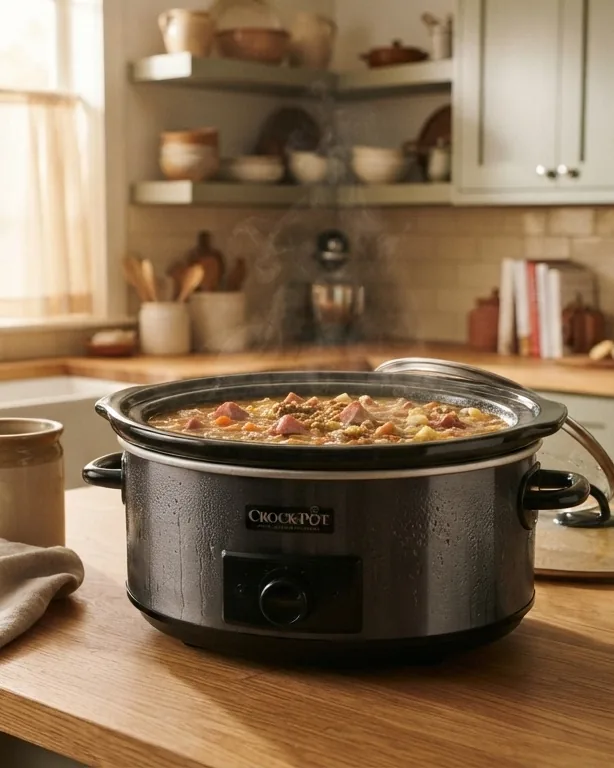
Fill your slow cooker no less than half and no more than two-thirds full, and run it on High for the first hour for even, safe heating. This is a food-safety instruction, not a serving suggestion. Underfill and the food heats unevenly and can dry out; overfill and the center never reaches a safe temperature fast enough. Colorado State University Extension makes this explicit in its crockpot and slow-cooker food safety guidance, recommending that half-to-two-thirds range and the High first hour. For ham and lentil soup, choose a cooker sized to comfortably fit your batch within that fill window – a larger cooker for a family-size batch, a smaller one for a half batch.
The first hour on High matters because it moves the whole pot through the temperature range where bacteria multiply fastest. Once it is bubbling and hot, drop to Low to finish. Skipping that step, especially with a full crock of cold ingredients, leaves the center sitting warm-but-not-hot for too long.
A slow cooker itself cooks at a temperature high enough to be safe, per USDA Food Safety and Inspection Service, once the food is actually up to temperature. The catch is the climb, which is why fill level and that first hour do real work. You can read the agency’s full breakdown in the USDA FSIS slow cookers and food safety guide.
Food Safety For A Cured-Meat And Legume Pot: Temps That Matter
Food safety is where a ham-and-legume soup demands more care than plain vegetable soup, and it is exactly where the top recipes go quiet. Bacteria grow rapidly between 40 and 140 degrees Fahrenheit, the range USDA Food Safety and Inspection Service calls the Danger Zone. Your job across a long cook is to move food through that band quickly and then hold it above it. Thaw any frozen meat in the refrigerator before it goes in the crock, never from frozen, because a slow cooker cannot heat frozen meat through the Danger Zone fast enough. Once the soup is done, a slow cooker on Warm holds already-hot food safely at 140 degrees Fahrenheit or above.
Reheating has its own rules, and they trip people up. Reheat leftovers to 165 degrees Fahrenheit, and do not use the slow cooker to reheat, because the appliance is built to hold hot food, not to bring cold food back up through the Danger Zone. Bring leftovers to a boil on the stove or nuke them to 165, then move them to the crock only if you want to keep them warm for serving.
- Danger Zone: 40 to 140 degrees Fahrenheit, per USDA FSIS. See the USDA FSIS Danger Zone explainer.
- Holding: keep finished soup at 140 degrees Fahrenheit or above on Warm.
- Reheating: 165 degrees Fahrenheit, on the stove or microwave, not in the cooker.
Ham has a specific reheat target too. Leftover or repackaged spiral-cut ham must be reheated to 165 degrees Fahrenheit, while ham that is still in its unopened plant-sealed package can be warmed to 140 degrees Fahrenheit. If you are reheating a whole leftover ham before shredding it into soup, the oven method runs about 10 minutes per pound at 325 degrees Fahrenheit. The Food Safety and Inspection Service lays out all of this in its hams guidance, and the same 165-degree floor for previously handled ham is the number to remember for your soup.
How long leftovers actually keep
Cooked leftovers keep 3 to 4 days in the refrigerator or 3 to 4 months in the freezer, according to USDA Food Safety and Inspection Service and the FoodSafety.gov Cold Food Storage Chart. Cool the soup down promptly, store it in shallow containers so it chills fast, and label the date. Beyond those windows, quality and safety both slide, so freeze what you will not eat within four days rather than pushing the fridge limit.
Nutrition By The Numbers: Protein, Fiber, And Why Lentils Earn The Bowl
Lentils are the reason this soup punches above its cost, and the numbers back it up. A half-cup cooked serving of green lentils provides about 32 percent of the Daily Value for fiber and about 9 grams of protein, per the USA Dry Pea and Lentil Council resource guide. Lentils.org, run by the Saskatchewan Pulse Growers, puts a half-cup cooked serving at about 12 grams of protein. Pair that plant protein and fiber with the ham’s savory hit and you get a bowl that stays with you, which is why budget-minded cooks like Living Lou reach for it. It is naturally low in fat and carries useful iron and folate.
Those two figures give a working range. Depending on lentil variety and how it is measured, a half-cup cooked lands somewhere around 9 to 12 grams of protein, which stacks up fast once you eat a full bowl of two or three servings.
- Fiber: about 32 percent of the Daily Value per half-cup cooked green lentils (USA Pulses).
- Protein: about 9 grams per half-cup (USA Pulses) to about 12 grams per half-cup (Lentils.org).
- Fat and micronutrients: naturally low in fat, a source of iron and folate.
If you want to see how these numbers stack against other bowls, the ingredient-by-ingredient math in the taco soup nutritional information breakdown uses the same kind of per-serving accounting. You can also check the primary source directly at the Lentils.org nutritional information page.
Stovetop And Instant Pot: The Same Soup, Different Clocks
The slow cooker is not the only route, and switching methods only changes the clock, not the ingredients. On the stovetop, build the mirepoix in the pot, add broth, lentils, and ham, then simmer covered until the lentils are tender, checking earlier than you would for a crock since direct heat works faster. In an Instant Pot or other electric pressure cooker, the same soup cooks in a fraction of the time under pressure, then needs a natural release so the lentils settle rather than foam through the valve. Julia’s Album is the one top result that spans slow cooker, stovetop, and Instant Pot in a single recipe, and the principle it uses holds across all three.
Whichever method you pick, the rules that make or break the pot do not move. Use green or brown lentils. Hold your salt until the end. Add greens and acid at the finish. Match the ham handling to its format. A pressure cooker will get you there in an evening; the crock trades time for a hands-off day.
Fixing A Hard, Salty, Or Too-Thick Pot
Most ruined batches trace back to three problems, and each has a clean fix. Lentils that stay hard after a full cook usually mean old lentils, hard mineral-rich water, or acid added too early, since acid slows lentils from softening. Add the vinegar or lemon only at the end, cook longer if the lentils are simply stubborn, and buy fresh lentils next time rather than the bag that has sat in the pantry a year. Too salty almost always comes from a salty ham bone plus salted broth, so dilute with unsalted broth or water and add more lentils or a diced potato to absorb some of the salt. Too thick is the easiest fix of all.
Lentil soup thickens as it chills because the lentils keep drinking liquid, so a pot that was perfect at dinner turns to sludge in the fridge. Thin it with broth or water on reheat until it flows again, then bring it to 165 degrees Fahrenheit.
- Still hard: old lentils, hard water, or early acid. Cook longer, add acid at the end.
- Too salty: dilute with unsalted broth; add a diced potato to absorb salt.
- Too thick after chilling: loosen with broth on reheat; expect thickening as it cools.
- Too thin: mash some lentils against the side of the pot to release their starch.
For a vegetarian version, drop the ham entirely and lean on smoked paprika or a little liquid smoke to replace the cured depth. Split peas swap in for lentils if you want a smoother, sweeter pot; the cozy slow cooker split pea soup recipe walks through that route with the same low-and-slow logic.
What the test kitchen crowd and the food-safety agencies agree on is that the fundamentals are boring and reliable: the right legume, controlled salt, safe temperatures, and a bright finish. Here is the short version of what actually moves the needle.
Frequently Asked Questions
Do I need to soak lentils before slow cooking?
No. Green and brown lentils go into the slow cooker dry, straight from the bag, with no presoak and no precook. That dump-and-go simplicity is the whole appeal. Rinse and pick them over first to remove dust and the odd small stone, then add them with your broth and ham. Red and yellow lentils are the exception, but not for soaking; they simply dissolve fast.
Can I put a frozen ham bone straight into the slow cooker?
No. Thaw meat in the refrigerator before it goes in the crock. A slow cooker cannot move frozen meat through the Danger Zone of 40 to 140 degrees Fahrenheit fast enough, per USDA Food Safety and Inspection Service. Thaw a ham bone or shank fully first, then add it. This applies to any meat you add, not just ham, because safe cooking depends on a fast, even climb to temperature.
Why did my lentils stay hard even after a long cook?
Three common culprits. The lentils may be old, since dried lentils that have sat for a year resist softening no matter the time. Your water may be hard and mineral-rich, which slows them down. Or you added acid, like vinegar or tomatoes, too early. Acid keeps lentils firm, so add it only at the end and give stubborn lentils more time.
How long does ham and lentil soup keep, and can I freeze it?
Cooked leftovers keep 3 to 4 days in the refrigerator or 3 to 4 months in the freezer, per USDA Food Safety and Inspection Service and the FoodSafety.gov Cold Food Storage Chart. Cool it fast in shallow containers, label the date, and freeze what you will not finish in four days. Expect it to thicken when chilled, so loosen it with broth on reheat.
What is the right way to reheat this soup?
Reheat to 165 degrees Fahrenheit on the stove or in the microwave, not in the slow cooker. The appliance is designed to hold already-hot food at 140 degrees Fahrenheit or above, not to bring cold food back up safely. Bring the soup to a full boil, stir it well so the center heats through, and add a splash of broth to thin the chilled, thickened texture.
Can I make it vegetarian without losing the smoky depth?
Yes. Drop the ham entirely and replace its cured, smoky flavor with smoked paprika or a small amount of liquid smoke. You keep the lentils’ protein and fiber, about 9 to 12 grams of protein per half-cup cooked depending on the source, and lose only the sodium and fat the ham contributes. Split peas also swap in well for a smoother, slightly sweeter pot.