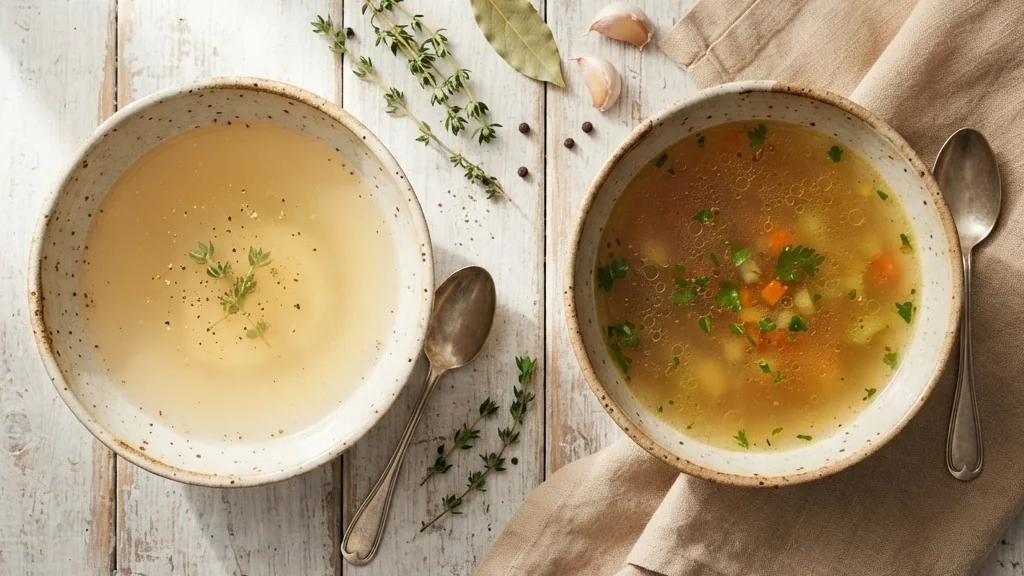
Difference between chicken stock and chicken broth comes down to two variables you can actually measure: how much gelatin the liquid carries, and how many milligrams of sodium ride along with it. Everything else is vocabulary. The cookbook rule says bones make stock and meat makes broth, which is true in a professional kitchen and close to meaningless in a supermarket aisle, because the word printed on a carton in the United States carries no legal weight at all.
Home cooks hit this every week. You simmer a carcass, chill it, and find a solid gel; you buy a carton labeled stock, chill it, and find water with chicken flavoring. Both liquids came out of a pot the same way you would how to boil chicken for soup, and yet they behave nothing alike once heat and reduction go to work on them.
Quick answer: stock is made from bones and connective tissue, simmered long enough to convert collagen into gelatin, and traditionally left unsalted so it can be reduced. Broth is made from meat, seasoned, and drinkable as it is. The difference between chicken stock and chicken broth disappears on a US label, because the Food Safety and Inspection Service makes no distinction between the two terms. Judge a carton by three things instead: whether it gels when chilled, sodium milligrams per 245 g serving, and grams of protein per cup.
What separates the two liquids in the pot
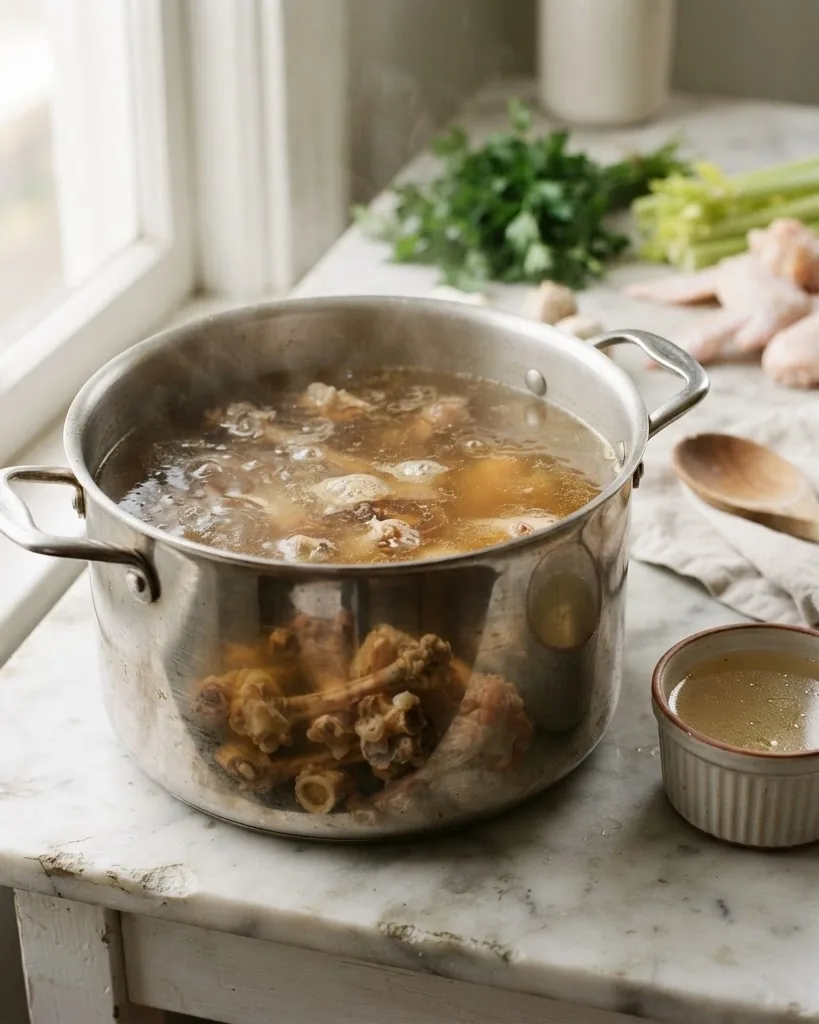
Stock is built from bones, joints and cartilage, and it is usually left unsalted. Broth is built from meat, and it is usually seasoned enough to drink straight from the mug. Bones carry collagen; long, gentle moist heat converts that collagen into gelatin, and gelatin is what gives a sauce body, cling and a chilled wobble.
Meat pulls in a different direction. It donates soluble savory compounds and aroma, so a well-made broth tastes more aggressively of chicken while setting barely at all in the refrigerator. The Academy of Nutrition and Dietetics frames the split the way most professional kitchens do: bone-based liquid is an ingredient, flesh-based liquid is a finished food. Simmer time follows the same logic, running 3 to 8 hours for stock depending on which bones go into the water, since marrow and connective tissue surrender their collagen slowly.
Clarity is the other half of the technique. Harold McGee, in On Food and Cooking, explains that classical stock method is largely about removing soluble cell proteins that coagulate into grey particles as the pot heats. A hard boil undoes that work: it emulsifies fat into the liquid and shreds solids into suspension, which is why a cloudy pot is almost always a temperature problem rather than an ingredient problem.
French kitchen vocabulary is more precise than English here, and worth borrowing. Fond blanc is white stock from unroasted bones. Fond brun is brown stock from roasted bones, where Maillard browning changes both the color and the depth of the finished dish. Remouillage is the thinner second extraction from bones already used once. Consomme is broth clarified and fortified until it runs bright. Auguste Escoffier codified the whole family as fonds de cuisine, the foundations of cooking, and The Culinary Institute of America still teaches white and brown stock as separate preparations in The Professional Chef.
The white and brown split is not cosmetic. A white stock uses a white mirepoix, typically onion, leek, fennel and celery, left pale on purpose so it will not muddy a cream soup or a veloute. A brown stock starts with roasted bones and a standard mirepoix of onion, carrot and celery, browned alongside the bones so the finished liquid reads dark enough for a demi-glace or a pan gravy. Choosing the wrong one is a common home-kitchen mistake: a roasted brown stock in a delicate cream soup will muddy the color even though the flavor is fine.
Purity is a textbook construct, though. Most homemade stock carries some meat, and most broth carries some bone, which is exactly why the two words blur even before a marketing department gets involved. If you want the culinary side of the question laid out on its own, our piece on is chicken stock the same as broth covers the kitchen definitions in detail.
Why the carton does not tell you what is inside
The Food Standards and Labeling Policy Book, the day-to-day labeling reference maintained by the US Department of Agriculture Food Safety and Inspection Service, states that no distinction has been made between broth and stock, and suggests the terms may be used interchangeably. That is the whole regulatory answer. A brand can print either word on either liquid without breaking a rule.
FSIS derives that authority from the Federal Meat Inspection Act and the Poultry Products Inspection Act, and it applies the same logic elsewhere in its own glossary. Bone-in poultry injected with a solution containing butter or other edible fat, broth, stock or water plus spices and approved flavor enhancers has to be labeled basted or self basted. Broth and stock sit in one undifferentiated list, in federal text, as substitutable inputs.
| Term | Classical kitchen meaning | Federal labeling reality |
|---|---|---|
| Stock | Bones and connective tissue, unsalted, gelatin-rich | Interchangeable with broth |
| Broth | Meat, seasoned, drinkable as served | Interchangeable with stock |
| Bone broth | Stock cooked longer, often with acid, salted for sipping | No separate standard |
The measured evidence backs the regulatory shrug. America’s Test Kitchen compared Swanson chicken stock against the same brand’s broth and found 510 mg of sodium per cup in the stock against 550 mg per cup in the broth, a gap of 40 mg, roughly 7 percent. Tasters also called the broth both more seasoned and bolder in chicken flavor, reversing the brand’s own positioning of stock as the meaty, less seasoned option for gravies and pan sauces.
Professionals collapse the terms too. Ina Garten’s widely copied chicken stock recipe starts with three 5-pound store-bought rotisserie chickens, which is 15 pounds of cooked meat, as Food52 has pointed out. By the classical definition that pot produces broth.
The comparison that stings: animal feed has a tighter definition than human food. The Association of American Feed Control Officials defines stock or broth for pet food as material obtained by cooking mammalian or poultry bones, parts or muscle tissues, with crude protein of at least 90 percent on a dry-matter basis. Your dog’s ingredient list is held to a number. Yours is held to a synonym.
Reduced sodium and low sodium are different claims
Two federal agencies split this job, and the split explains most shelf confusion. FSIS approves the label on a meat or poultry product. The US Food and Drug Administration writes the nutrient-claim vocabulary that appears on that label, under Title 21 of the Code of Federal Regulations. Part 101.12 sets the Reference Amount Customarily Consumed, or RACC, at 245 g for all soup varieties, which is close enough to a cup that per-serving numbers compare cleanly across brands. Part 101.61 sets what the sodium words are allowed to mean.
| Claim on the carton | Legal threshold (RACC above 30 g) |
|---|---|
| Sodium free or salt free | Under 5 mg per serving |
| Very low sodium | 35 mg or less per 245 g |
| Low sodium | 140 mg or less per 245 g |
| Reduced or less sodium | At least 25 percent below the reference food |
| Light in sodium | At least 50 percent below the reference food |
Run a real number through that table. A broth at 570 mg per cup can legally carry a reduced sodium flag if the brand’s own baseline was high enough, while sitting 430 mg above the 140 mg ceiling that low sodium requires. Same shelf, same shopper, two claims that sound like cousins and differ by a factor of four.
Reduction makes the gap worse. Cook that 570 mg cup down 4:1 for a pan sauce and the finished cup lands near 2,280 mg. Salt does not evaporate.
The practical shopping rule follows directly from the two thresholds. If a recipe calls for reducing the liquid by half or more, buy the product marked low sodium, not reduced sodium, because only the 140 mg ceiling guarantees a safe finished number after concentration. Save the reduced sodium carton for dishes that stay at full volume, such as a clear soup or a braise where the liquid is mostly absorbed rather than boiled away.
The 12-hour fridge test that settles the difference between chicken stock and chicken broth
Pour one cup from the carton or the pot, cover it, and hold it at 40 degrees F or below for 12 hours. If it sets firm enough to jiggle when you tilt the container, the liquid is gelatin-rich and will behave like stock: it will cling to a spoon, thicken a pan sauce without added starch, and give a braise a glossy finish. If it stays loose, treat it as broth no matter which word the package uses. The test costs nothing, needs no equipment, and answers the only question that changes how the liquid performs on the stove. A failed gel is not a defect; it simply means you should reach for a thickener or a longer reduction.
A partial gel, somewhere between a firm set and plain liquid, is common with store-bought cartons that blend bone extract with water and a small amount of gelatin as a thickener. Treat a partial gel as a mid-point: expect some cling in a pan sauce, but plan to finish with a small amount of butter or a cornstarch slurry rather than relying on the liquid alone.
Substitution math, dish by dish
A 1:1 volume swap works for nearly everything a home cook makes, and the correction you need is almost always about salt rather than volume. The rule of thumb: unsalted stock can be seasoned up at any point, while salted broth can only be diluted or left alone. Reductions and long-cooked sauces punish the second case hardest, since concentration multiplies whatever sodium started in the pan. Anything that mostly evaporates or gets absorbed, such as rice, beans or a covered braise, is forgiving either way.
| Dish | Using salted broth where stock is called for | Using unsalted stock where broth is called for |
|---|---|---|
| Pan sauce | Never reduce beyond about 2:1 without tasting | Season off heat, at the end |
| Gravy | Skip added salt entirely until the flour cooks out | Salt after thickening, in stages |
| Risotto | Cut with water, since salt compounds over each ladle | Season the finished pan, not the stock |
| Clear soup | Use as is | Add salt and aromatics before serving |
| Beans and grains | Reduce salt elsewhere in the recipe | Salt once the grain is tender |
Body is the other axis. Braised thighs and anything destined for a bowl of chicken pasta benefit from gelatin, because the sauce needs to coat rather than pool. A brothy noodle soup wants the opposite, which is why Marry Me chicken soup reads as comfort food rather than restaurant sauce.
Bouillon cubes, pastes and concentrates are the third option, and usually the saltiest per finished cup, so treat them as seasoning rather than liquid. Water plus an onion, a carrot and a bay leaf beats an over-salted shortcut. Coating dishes such as air fryer chicken rarely need either, since almost no liquid stays in the pan.
Ramen is the extreme case for gelatin. A tonkotsu-style bowl depends almost entirely on stock behavior, since the cloudy, body-heavy broth that defines the style comes from hours of hard-simmered bones releasing collagen and a small amount of emulsified fat. Substituting a thin, unreduced broth here will not fail the recipe outright, but it will produce a bowl that tastes right and feels thin, since the mouthfeel is the point of the dish as much as the flavor.
How to make stock and broth at home
Stock starts with bones, roasted or not depending on color goals, plus a standard mirepoix of onion, carrot and celery, a few aromatics such as bay leaf, peppercorns and parsley stems, and a cold-water start. Bring the pot up slowly, skim the grey foam that rises early on, then hold it at a bare simmer until the bones give up their gelatin. Strain through a fine mesh, and leave it unsalted so it can be reduced later without oversalting the finished dish.
Broth follows a shorter, simpler path. Start with meat, often a whole bird or a carcass that still carries some flesh, cover with cold water, add the same aromatics, and simmer for roughly 1 to 2 hours, just long enough to pull flavor and moisture out of the meat without shredding it into the liquid. Season broth as you go, since it is meant to be tasted and served on its own rather than reduced into something else.
A rotisserie chicken carcass is the fastest route to a usable batch of either. Strip the meat for sandwiches or soup, then simmer the bones and skin with the same aromatics; the short prior cooking time already broke down some connective tissue, so the gel test often surprises people who expected a weaker result from scraps.
Equipment changes the timeline but not the chemistry. A stovetop pot gives the most control over simmer temperature and is easiest to skim. A slow cooker holds a gentle, hands-off simmer overnight, useful when you want it hands-off, though it is harder to skim early foam. A pressure cooker raises the boiling point and reliably produces a firm gel because the higher temperature accelerates collagen breakdown; the tradeoff is a slightly cloudier result unless you strain carefully afterward.
Defatting matters for both. Chill the strained liquid overnight and a solid cap of fat will rise and set on top, lifting off cleanly with a spoon. Skipping this step leaves a greasy film on any finished sauce and can make the gel test harder to read, since fat can mask a weak set underneath.
The protein and sodium ladder
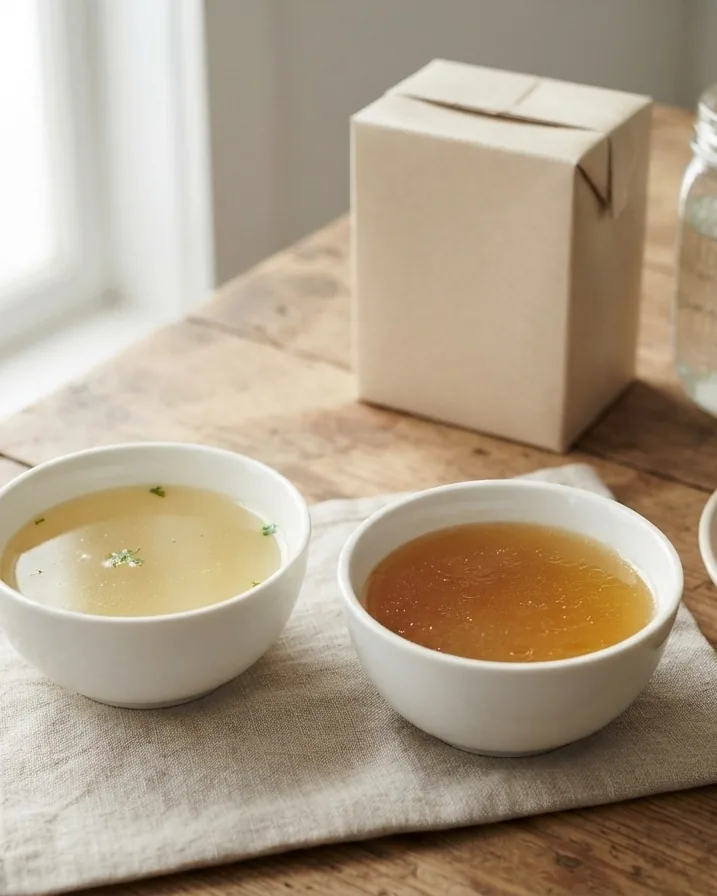
Per cup, plain broth carries roughly 1 g of protein, stock roughly 4 g, and bone broth roughly 10 g, according to dietitian-sourced figures. That is a tenfold spread between the two ends and the honest reason to pay a premium for bone broth, ahead of any collagen marketing. USDA FoodData Central puts canned ready-to-serve chicken broth at about 14 kcal, 2 g of protein and 890 mg of sodium per 240 g cup. The low-sodium canned entry runs about 96.2 percent water and 2 percent protein by weight, while the reduced-sodium ready-to-serve version runs about 98.2 percent water and 1.4 percent protein. None of it is a serious protein source at one cup, which is why high-protein recipes use these liquids as a base rather than a headline ingredient.
Collagen and gelatin health claims sit ahead of the evidence in most marketing copy. Bone broth’s higher protein number is real and measurable, and gelatin does make a meaningfully different mouthfeel in a finished dish. Specific claims about joint health, skin elasticity or gut healing from drinking bone broth are not established at the level the marketing implies, and neither stock nor broth should be treated as a primary protein source at typical serving sizes.
Cooling a full stockpot without breaking the safety window
A gallon of hot stock is one of the hardest things a home kitchen has to cool safely, and the standard is specific. Federal guidance, echoed by Michigan State University Extension, sets two stages: 140 degrees F down to 70 degrees F within 2 hours, then 70 degrees F down to 40 degrees F within 4 more hours, for a total cooling time of 6 hours or less. Miss the first stage and the fix is to reheat to 165 degrees F and start over. Miss the second and the pot goes in the trash. Perishable food should never sit at room temperature longer than 2 hours, or 1 hour once the room passes 90 degrees F.
Depth is the enemy. A stockpot left on the counter to cool overnight coasts through the danger zone for hours, so decant into shallow containers, or float the pot in an ice bath and stir. FSIS puts cooked leftovers at 3 to 4 days in the refrigerator, and reheating back to 165 degrees F before serving. Freeze in cup portions and a weeknight cozy chicken broth bowl takes minutes; if you are tracking sodium across a whole meal, our breakdown of taco soup nutritional information shows how fast the numbers stack up.
Ice-cube trays solve the small-portion problem for both stock and broth. A standard tray holds roughly 2 tablespoons per cube, which is enough for a quick pan sauce or to deglaze a skillet without thawing a whole quart. Once frozen, transfer the cubes into a labeled freezer bag so the tray stays free for the next batch.
Troubleshooting common problems
A cloudy stock almost always traces back to a boil rather than a simmer, since a hard boil emulsifies fat into the liquid and shreds solids into suspension. Lower the heat, strain again through a cloth-lined sieve, and skim more aggressively at the start of the next batch. A stock that will not gel usually has too little bone relative to water, too short a simmer, or bones that were already spent from an earlier remouillage. A broth that tastes flat despite a long simmer is often under-salted rather than under-flavored; season at the end, in small additions, tasting each time.
What to keep on the shelf
Buy one unsalted or low-sodium carton for sauces and reductions, one seasoned carton for drinking and quick soups, and run the gel test on both the first time. After that you will know what each product actually is, regardless of the noun on the front. Keep a bag of frozen carcasses for the real thing, and use the good gelled batch where texture matters, such as a cozy mini matzah ball soup.
Frequently asked questions
Can I use chicken broth instead of stock in a pan sauce?
Yes, with one guardrail. Broth is already seasoned, so avoid reducing it beyond roughly 2:1 without tasting, and hold off on any added salt until the sauce is finished. Expect less cling, since broth carries little gelatin; a small knob of butter or a starch slurry restores the body you lose.
Is bone broth the same thing as stock?
Functionally, close to it. Both start with bones and connective tissue, and both rely on long moist heat to convert collagen into gelatin. Bone broth generally cooks longer, often includes an acid such as vinegar to help break down connective tissue, and arrives salted for sipping at roughly 10 g of protein per cup.
Which one is healthier, stock or broth?
Sodium decides it, and the label word does not predict sodium. America’s Test Kitchen measured only a 40 mg per cup gap between one brand’s stock and broth. Compare the Nutrition Facts panel against the 245 g reference serving, check protein grams, and remember that homemade unsalted stock is the only fully controlled option.
Why did my homemade stock stay liquid in the fridge?
Not enough collagen reached the water. Common causes: too little bone relative to liquid, too short a simmer, or bones already spent from an earlier batch. Boiling instead of simmering will not help either, since a hard boil clouds the pot without improving gelatin extraction.
What separates bouillon, consomme and broth?
Bouillon is a concentrate, sold as a cube, paste or powder, and typically the saltiest per finished cup. Consomme is broth clarified and fortified until it runs bright and tastes concentrated. Broth sits between them as a ready-to-eat liquid built from meat, seasoned and drinkable without any further work.
Does the word on the label mean anything legally?
No. The Food Standards and Labeling Policy Book from FSIS records no distinction between broth and stock and treats the terms as interchangeable. The same glossary lists broth, stock and water together in its basted poultry definition. Judge a product by gel behavior, sodium per 245 g and protein grams instead.
Is chicken base the same thing as stock or broth?
Chicken base is a concentrated paste made by reducing stock or broth with added salt and often fat, meant to be reconstituted with water at a ratio set by the manufacturer, usually around one teaspoon per cup. It behaves more like bouillon than like a ready-to-use liquid, so treat the sodium on its label as the concentrated number, not the diluted one, before adding it to a recipe that already calls for salt.