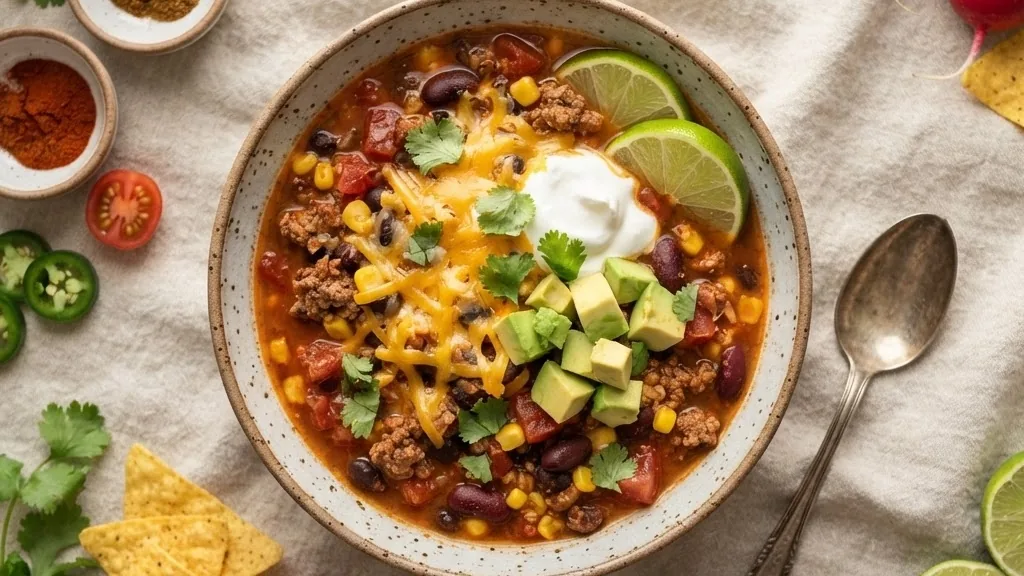
Taco soup nutritional information is not one number, and that is the first thing worth fixing about how the internet talks about this dish. A plain cup logs around 197 calories on the FatSecret database, yet a homemade beef and bean pot lands near 364.2 calories per serving, while a lean chicken version drops to 125 calories per cup. Same name, roughly a fourfold spread. The gap comes from protein choice, portion size, and what you pile on top, not from any single “correct” recipe. If you have ever cross-checked two calorie apps and gotten two different answers, this is why. Before you trust any single figure, it helps to know which build it describes and how the plate was divided. For a topping-by-topping companion table, our full breakdown by version and topping pairs well with the numbers below.
Quick answer: Taco soup nutritional information ranges from about 125 to 475 calories per serving depending on protein and portioning. A generic cup is roughly 197 calories. A homemade beef and bean bowl runs about 364.2 calories with 21.8 grams of protein and 8.2 grams of fiber. Lean chicken builds cut that to 125 calories per cup. Sodium is the real health flag: seasoning-packet versions clear 785 milligrams per serving, roughly a third of the FDA Daily Value of 2,300 milligrams, before any cheese or chips. Choose your protein, control your portion, and the number falls in line.
Calories Per Cup Versus Per Bowl
Calories in taco soup hinge on two decisions most tables skip: which protein went into the pot, and how big your ladle is. A standard cup of generic taco soup sits at 197 calories per the FatSecret database, a clean midpoint figure. Shift to a homemade beef and bean recipe and the SparkPeople breakdown puts one of six servings at 364.2 calories. Go lean with a chicken build and Health Beet lists just 125 calories per cup. That is the same dish covering a fourfold band.
A bowl is typically larger than a measuring cup, so the true per-bowl calorie count runs higher than the per-cup figure most tables quote. The restaurant version tilts higher still, a 16-ounce Hale and Hearty portion hitting 460 calories on Eat This Much. Portion honesty matters more than recipe swaps. Two cooks can follow the exact same recipe card and end up with different numbers purely because one used a 1-cup ladle and the other filled a soup mug that holds closer to 2 cups.
Here is the practical trap. Recipes yield six to eight servings, and the per-serving number assumes you divide the pot evenly. Ladle heavier and every figure climbs. If a recipe states “serves 6” and you and one other person eat the whole pot between you, you have effectively tripled every number on the label, sodium included.
- One cup, generic: 197 calories.
- One dinner bowl: more than the cup number, since a bowl typically holds more than a measuring cup.
- One homemade beef serving: 364.2 calories.
- One restaurant 16-ounce cup: 460 calories.
If your goal is a lighter weeknight pot, our quick and hearty taco soup recipe gives you a base you can portion tightly. Anyone building a batch around lean poultry should read how to boil chicken for soup first, since starting with clean, tender meat keeps the calorie math on the low end without adding fat. Weighing your finished pot on a kitchen scale and dividing by the stated serving count is the single most reliable way to know your real per-bowl number, more reliable than trusting any app’s default assumption about cup size.
The Full Macro Breakdown, Version By Version
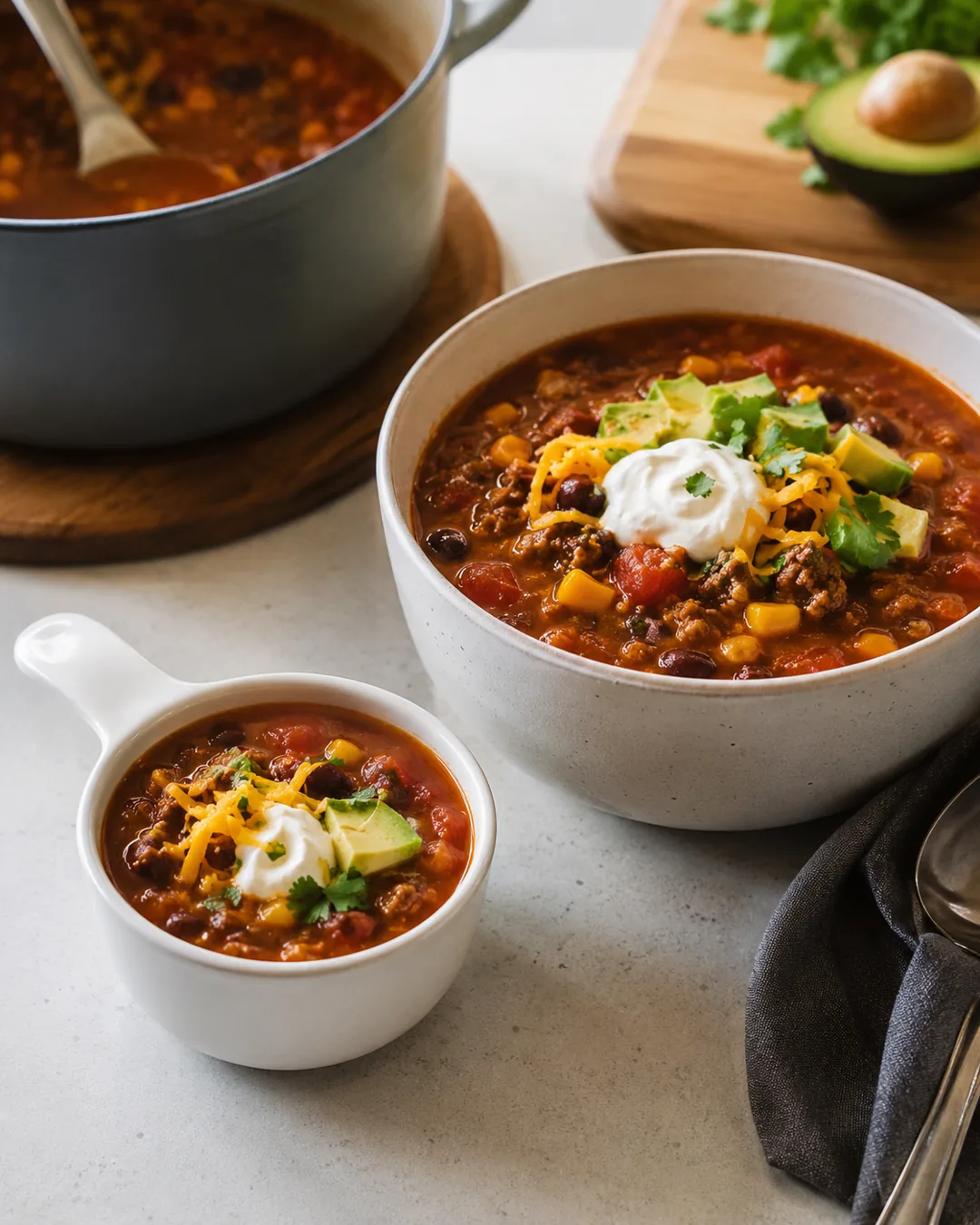
Macros are where taco soup earns its reputation as a high-return bowl, and where the aggregator pages fall short by publishing one row for a dish that swings hard. Protein is the headline. A homemade beef and bean serving delivers 21.8 grams of protein on the SparkPeople figures, and The Protein Chef’s slow-cooker build pushes that to 42 grams per serving. Carbohydrates track the bean and corn load, with the same slow-cooker version listing 43 grams of carbohydrate and 10 grams of fiber. Fat is the swing factor tied to your meat: 16.4 grams in the beef build, 15 grams in the high-protein version, and just 2 grams per cup in the lean chicken option from Health Beet.
Net carbohydrate is worth isolating separately, since it is the figure low-carb cooks actually track. Subtract fiber from total carbohydrate and the beef and bean serving, at 31.6 grams total carbohydrate and 8.2 grams fiber, works out to roughly 23.4 grams net carbohydrate. The slow-cooker version, at 43 grams total and 10 grams fiber, nets to about 33 grams. That distinction matters more than the headline carbohydrate figure for anyone counting toward a daily net-carb ceiling rather than a raw carbohydrate one.
Reading one number per dish hides all of that. A single comparison lays it bare:
- Lean chicken (1 cup): 125 calories, 15 g protein, 7 g carbohydrate, 2 g fat, 72 mg sodium, 1 g fiber.
- Homemade beef and bean (1 serving): 364.2 calories, 21.8 g protein, 31.6 g carbohydrate, 16.4 g fat, 648.0 mg sodium, 8.2 g fiber.
- High-protein slow-cooker (1 serving): 475 calories, 42 g protein, 43 g carbohydrate, 15 g fat, 785 mg sodium, 10 g fiber.
- Low-carb (1 serving): 280 calories, 27 g protein, 21 g carbohydrate, 10 g fat.
The United States Department of Agriculture reference database, USDA FoodData Central, is what underpins those per-ingredient values for ground beef, beans, corn, and tomatoes. When a calculator disagrees with a package label, it usually traces back to which FoodData Central entry the tool pulled. That sourcing difference can be one reason two nutrition apps disagree on what looks like the same bowl.
Beef, Turkey, Chicken, Or Vegetarian: A Side By Side
Protein source is the biggest lever on taco soup nutritional information, bigger than seasoning, bigger than toppings, bigger than brand. The lean chicken route is the lightest documented build at 125 calories and 2 grams of fat per cup, which is why it wins for calorie-cutters. Ground beef pushes fat up to 16.4 grams and calories to 364.2 per serving in the homemade version. A high-protein slow-cooker approach trades some restraint for muscle-fuel, landing at 475 calories and 42 grams of protein. Bean-forward and vegetarian builds lean on fiber and carbohydrate rather than animal fat, which is what keeps their saturated fat low. The takeaway is simple: pick the protein that matches your target, then let the rest of the recipe follow.
| Version | Calories | Protein | Sodium |
|---|---|---|---|
| Lean chicken (1 cup) | 125 cal | 15 g | 72 mg |
| Generic taco soup (1 cup) | 197 cal | not listed | not listed |
| Homemade beef and bean (1 serving) | 364.2 cal | 21.8 g | 648.0 mg |
| Low-carb (1 serving) | 280 cal | 27 g | not listed |
| High-protein slow-cooker (1 serving) | 475 cal | 42 g | 785 mg |
Notice the sodium column climbs with the packaged-seasoning builds. That is not the meat talking. Ground turkey, when you swap it for beef, tends to trim fat while holding protein near the chicken-to-beef midpoint, though it was not separately measured in the numbers above, so treat it as a lean-leaning stand-in rather than a logged figure.
Athletes chasing that 42-gram protein bowl often build a week of similar meals; a broader set of high-protein recipes shows how the same bean-and-lean-meat template scales beyond soup. And if you want to see the macro logic applied to a completely different comfort dish, the numbers behind a bowl of ham and lentil slow-cooker soup follow the same fiber-plus-protein pattern.
Vegetarian And Vegan Builds, And Who Should Watch Out
Taco soup converts to a fully vegetarian dish with almost no structural change, since the bean and tomato base already carries most of the flavor and body. Drop the meat, add an extra can of beans or a cup of corn to hold the texture, and the fiber number typically climbs while the fat number falls close to the lean chicken range. A vegan version needs a second look at the toppings rather than the base, since cheese and sour cream are the parts doing the animal-product work, not the soup itself.
Diet-fit tags are worth stating plainly rather than leaving implied. Taco soup in its base form reads as high-protein and gluten-free, though the seasoning packet is the one place gluten can hide, so a checked label matters for anyone strictly avoiding it. Keto and strict low-carb followers hit a wall at the bean load specifically, since beans are the fiber source and the carbohydrate source at once; cutting them cuts the fiber advantage along with the carbohydrate. Dairy-free eaters are fine with the base soup and only need to swap the toppings.
Allergens deserve a direct list rather than a footnote, since three of them show up in builds people do not expect:
- Dairy: from cheese and sour cream toppings, not the base broth.
- Gluten: possible in some packaged seasoning mixes, check the label.
- Celery: sometimes present in broth bases as a flavoring agent.
Sodium: The Number That Actually Hurts You
Sodium is the single health flag that most taco soup coverage ignores, and it is the one your heart cares about most. The FDA Daily Value for sodium is 2,300 milligrams per day. A high-protein slow-cooker serving already carries 785 milligrams, which is roughly a third of that ceiling before you add a single topping. The homemade beef and bean version is gentler at 648.0 milligrams, and the lean chicken build is remarkably low at 72 milligrams per cup, because it skips the packet. The driver is not the beans or the broth. It is the taco and ranch seasoning packets, which are engineered salt bombs. The American Heart Association pushes an even tighter ideal limit than the federal ceiling, which makes packet-heavy bowls a genuine concern for anyone watching blood pressure.
The fix is arithmetic, not sacrifice. Swap the packet for a do-it-yourself blend of cumin, chili powder, garlic, and oregano and you control the salt directly. Two seasoning packets a week, over a year, is a real and avoidable slice of total sodium intake, and the swap costs nothing beyond five minutes measuring spices you likely already own.
- Drain and rinse canned beans: removes a meaningful share of packing sodium.
- Choose no-salt-added tomatoes: a straight swap with no flavor loss.
- Skip the seasoning packet: the biggest single lever, worth hundreds of milligrams.
- Go lean-protein: the 72-milligram chicken build proves how low it can go.
The Dietary Guidelines for Americans, published jointly by the USDA and the Department of Health and Human Services, set the sodium and fiber intake targets that these swaps chase. Rinse, DIY the seasoning, and a 785-milligram bowl can shed a large slice of its salt without losing the smoky, layered flavor that makes taco soup worth making in the first place.
Fiber, Protein, And The Micronutrients Nobody Lists
Fiber is where taco soup quietly outperforms most weeknight dinners, and it comes almost entirely from the beans. The homemade beef and bean serving delivers 8.2 grams of fiber, and the high-protein slow-cooker version reaches 10 grams. Against the FDA Daily Value for fiber of 28 grams per day, a single bowl covers a real chunk. The NIH Office of Dietary Supplements is the body that governs the underlying nutrient recommendation values, the RDAs and DRIs, that those daily targets rest on. Beyond fiber and protein, the tomato base contributes vitamin C, the beans add potassium and iron, and the whole pot carries vitamin A from the peppers and tomatoes.
None of the aggregator pages break those micronutrients out, which is odd given they are half the reason to eat the dish. Iron in particular deserves a mention beyond a passing note, since the combination of beans and beef in one bowl delivers both plant-based and heme iron, a pairing that supports better absorption than either source eaten alone.
- Fiber: 8.2 to 10 grams per serving, from beans, against a 28-gram daily value.
- Protein: 15 to 42 grams depending on build.
- Vitamin C: from the tomato and pepper base.
- Potassium and iron: largely from the beans.
For a lighter bowl where the calorie count is the whole story, our look at how many calories are really in miso soup makes a useful contrast, since miso leans on umami and sodium rather than fiber and protein.
Toppings Math: What Your Add-Ons Really Cost
Toppings are the blind spot in every calorie count, because the base number always describes a bare bowl. Cheese, sour cream, avocado, and tortilla chips get layered on after the recipe was measured, which means the printed figure understates the plate in front of you. A base bowl at 364.2 calories can become something quite different once the garnishes land, and the aggregator pages simply do not account for it. That is the honest reason two people eating “the same” taco soup can be hundreds of calories apart. The base recipe is the floor. Your topping choices are the ceiling, and the ceiling is under your control at the table, spoon by spoon.
Build your bowl with intent rather than habit. A few swaps keep the character without stacking the total:
- Reach for avocado over sour cream when you want creaminess with unsaturated fat.
- Use crushed chips as a garnish, not a base layer.
- Grate cheese finely so a little reads as a lot.
- Add fresh cilantro, lime, and diced onion for flavor that costs almost nothing.
Order of operations matters more than people assume. Adding chips first and eating from the top means every spoonful front-loads the crunchy, calorie-dense layer, while stirring toppings evenly through the whole pot spreads the same total across every bite, which tends to feel more satisfying per calorie spent.
Homemade Versus Canned Versus Restaurant
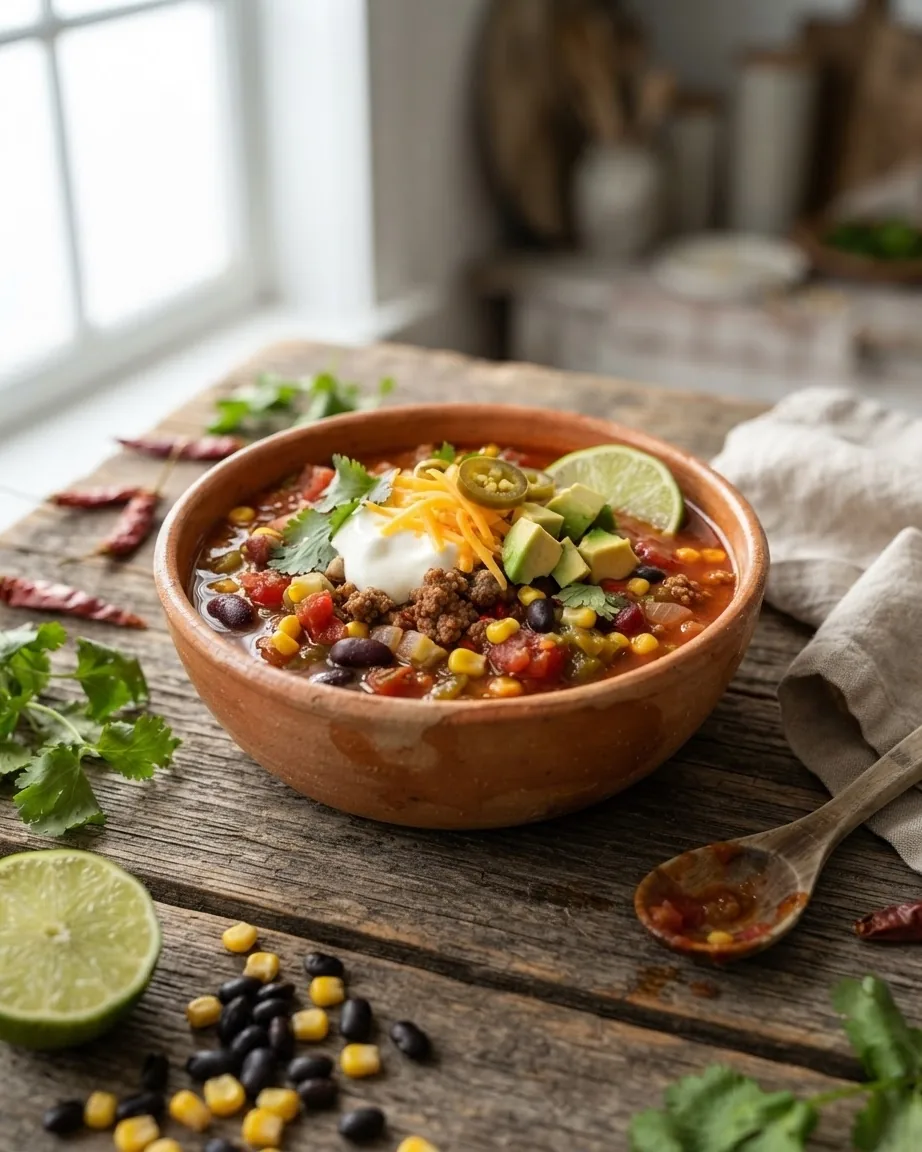
Where your taco soup comes from changes the math more than any topping. Homemade wins on control, with the beef and bean version landing at a knowable 364.2 calories and 648.0 milligrams of sodium per serving. The restaurant portion is the outlier: a 16-ounce Hale and Hearty cup on Eat This Much reads 460 calories with a macro split of 18 percent carbohydrate, 57 percent fat, and 25 percent protein. That fat-heavy split is the tell of a commercial kitchen cooking for flavor, not for macros. Canned versions sit between the two, convenient but salt-loaded by default.
Cook it yourself and you set the dial. The winter-bowl mindset in our roundup of the best soups worth making when it gets cold applies directly: a pot you build from scratch is almost always the leaner, cheaper option, and it is the only version where you actually know every ingredient that went in.
Reading The Label: How To Calculate Your Own Bowl
If none of the four documented builds above match your exact recipe, the fastest fix is building your own per-serving figure rather than guessing from a database entry meant for a different pot. Add up the nutrition label values for every canned and packaged ingredient, weigh or measure the finished pot, divide by the number of servings you actually plan to eat, and you have a number specific to your kitchen rather than a stranger’s.
- List every ingredient with a package or USDA FoodData Central value: meat, beans, tomatoes, corn, broth, seasoning.
- Sum calories, protein, carbohydrate, fiber, fat, and sodium across the whole pot.
- Weigh the finished, cooked pot in total grams or measure it in total cups.
- Divide the pot totals by your real serving count, not the recipe’s stated count if you portion differently.
This method also catches a mistake most calorie apps make silently: assuming water and broth cook off at a fixed rate. A soup simmered uncovered for an extra twenty minutes concentrates every nutrient per cup, since some water evaporates while the solids stay put. Measuring the finished volume, not the ingredient volume, is the only way to catch that shift.
How To Cut Calories And Sodium Without Losing The Bowl
Trimming taco soup down is a series of small, known swaps rather than one grand sacrifice. The lean chicken build already proves the ceiling can fall to 125 calories and 72 milligrams of sodium per cup, so the target is real, not aspirational. Start with the protein, since it moves fat the most, then attack the sodium at its source. Every change here traces back to a figure you have already seen.
- Swap beef for lean chicken to move from 16.4 grams of fat toward 2 grams per cup.
- Drop the seasoning packet to cut sodium from 785 milligrams toward the 72-milligram range.
- Rinse the beans and use no-salt-added tomatoes.
- Portion to the recipe’s stated six to eight servings instead of overfilling.
Odd as it sounds, the same precision that food scientists apply to coffee science works on a soup pot: measure the inputs, know the output. A vegetable-forward, protein-rich cousin like our black bean and sweet potato stew shows the same lean-build logic in a different bowl.
Frequently Asked Questions
How many calories are in a cup of taco soup?
A generic cup of taco soup is about 197 calories on the FatSecret database. The real range is wider: a lean chicken build drops to 125 calories per cup, while a homemade beef and bean serving reaches 364.2 calories. Your protein choice and how much you ladle decide where you land inside that band.
Is taco soup high in sodium?
It can be. Versions built on taco and ranch seasoning packets clear 785 milligrams of sodium per serving, roughly a third of the FDA Daily Value of 2,300 milligrams before toppings. A lean chicken build without the packet drops to just 72 milligrams per cup, so the salt is fixable with a do-it-yourself blend.
How much protein does taco soup have?
Protein ranges from 15 grams per cup in a lean chicken build to 42 grams per serving in a high-protein slow-cooker version. A homemade beef and bean bowl sits in the middle at 21.8 grams. The beans contribute steadily, and the meat choice sets the ceiling for how high the protein climbs.
Is taco soup a good source of fiber?
Yes. A homemade beef and bean serving carries 8.2 grams of fiber, and a slow-cooker version reaches 10 grams, both meaningful against the FDA Daily Value of 28 grams per day. The beans do the heavy lifting, which is why bean-forward and vegetarian builds tend to hit the higher fiber numbers.
Can taco soup fit a low-carb diet?
A dedicated low-carb version lands at 280 calories, 21 grams of carbohydrate, and 27 grams of protein per serving. The bean load is the usual blocker for strict keto, so reducing beans and leaning on meat and low-carb vegetables is the path. Check the seasoning too, since some mixes add hidden carbohydrate.
Does the restaurant version differ much from homemade?
Considerably. A 16-ounce Hale and Hearty portion reads 460 calories with a fat-heavy split of 57 percent fat, versus a controllable 364.2 calories in a homemade beef bowl. Cooking it yourself lets you set the sodium and fat directly, which the restaurant kitchen optimizes for flavor instead.
Is taco soup gluten-free?
The base of beans, tomatoes, corn, and meat is naturally gluten-free. The one place gluten can hide is the seasoning packet, since some commercial blends use wheat-based anti-caking agents. A homemade cumin, chili powder, garlic, and oregano blend sidesteps the question entirely and keeps the sodium lower at the same time.
The Bottom Line On The Numbers
Taco soup covers a genuine fourfold calorie range, from 125 calories per cup in a lean chicken build to 475 calories in a high-protein slow-cooker serving, and no single database entry captures that. Protein choice, portion size, sodium from packets, and toppings are the four dials, and every one of them sits in your hands at the stove. Anchor to the USDA FoodData Central values, respect the FDA Daily Value ceilings for sodium and fiber, and the dish reads as what it is: a high-fiber, high-protein bowl that only turns heavy when the salt and garnishes get careless. Cooks who love a hearty pot with a twist should peek at the flavor-first approach in this marry me chicken soup or the vendor tricks behind the best mobile food trucks, both of which lean on the same seasoning discipline that keeps taco soup honest.