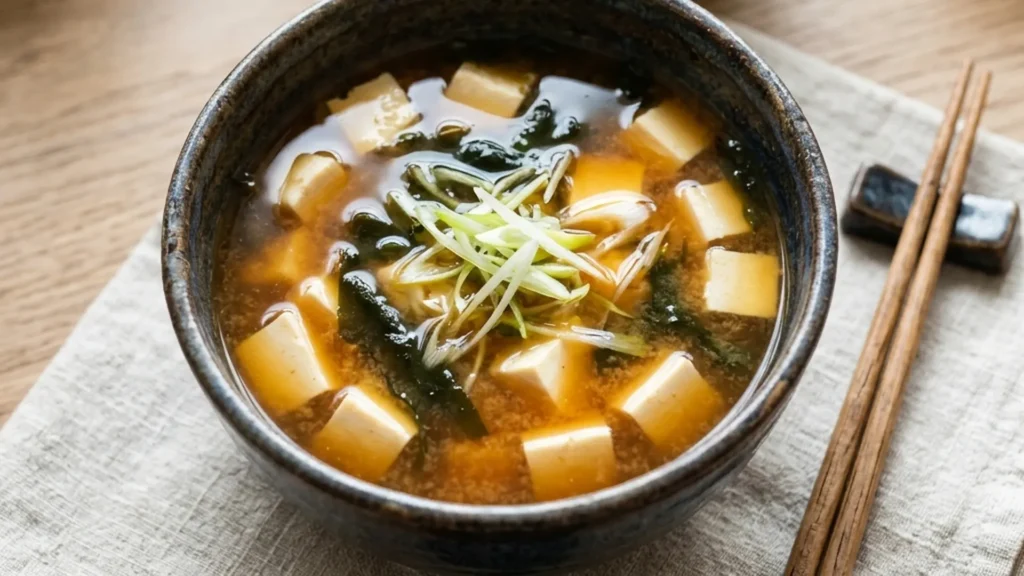
Miso soup calories land remarkably low, with a basic bowl of dashi and miso paste running just 35 to 60 calories per cup, and a standard restaurant version with tofu and scallions coming in around 75 to 100. That makes miso soup one of the lightest soups you can eat, with most of the calories coming from the miso paste itself rather than the broth. Add tofu, seaweed, and a few vegetables and you are still under 110 calories a cup, which is why it shows up so often on diet and fasting menus.
I make miso soup a couple of times a week, usually as a quick lunch or a warm-up before a bigger meal, and the calorie question comes up constantly. The trouble with most answers online is that they quote one vague range and stop. The real number depends entirely on what goes in the bowl, and the calories are not the only thing worth tracking, because miso soup carries a serious sodium load. Here is the full picture: the calories by version, exactly what each add-in contributes, how homemade compares to restaurant and instant, and how to keep the bowl as light as it deserves to be.
Miso soup calories by version
The base of miso soup is almost free on calories. Dashi, the Japanese stock made from kombu and bonito, has barely any. Nearly all the calories come from the miso paste and whatever you add. Here is how the common versions stack up per 1-cup serving.
| Version (per 1 cup) | Calories | Protein | Sodium |
|---|---|---|---|
| Plain (dashi + 1 Tbsp miso) | 35-50 | 2-3g | 600-800mg |
| Classic (miso, tofu, scallion, wakame) | 75-100 | 5-7g | 700-900mg |
| Vegetable-loaded | 90-120 | 5-8g | 700-900mg |
| With pork or seafood | 200-250 | 12-18g | 900-1100mg |
So the honest range for a normal bowl is 35 to 120 calories, and only the meat-or-seafood versions climb past that. The macros are mostly a little protein and a few grams of carbohydrate, with very little fat. The number that should actually catch your eye is the sodium, which I will get to, because it is the real story in miso soup.
What each add-in actually adds
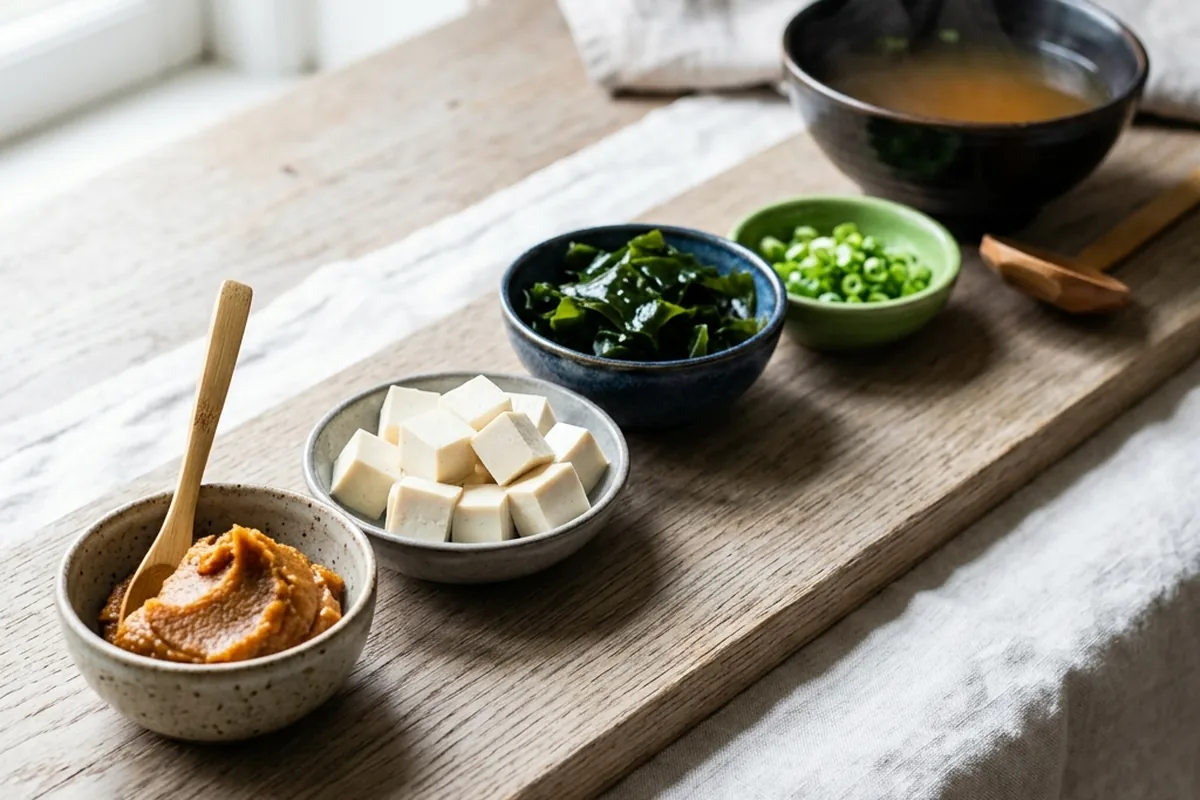
This is the breakdown nobody else gives you, and it is the most useful part if you are counting. Once you know what each ingredient contributes, you can build a bowl to whatever calorie target you want. These are approximate per typical portion in one bowl.
- Miso paste (1 Tbsp): about 30 to 40 calories. This is the single biggest source in a plain bowl, and using more paste adds both calories and a lot of salt.
- Silken tofu (1/4 cup cubed): roughly 20 calories, plus a couple grams of clean protein. The classic add-in and well worth it.
- Wakame seaweed (1 Tbsp rehydrated): about 5 calories. Essentially free, and it brings minerals and that signature ocean flavor.
- Scallion (1 Tbsp sliced): 2 to 3 calories. Free for all practical purposes.
- Mushrooms (1/4 cup): about 5 calories. Add umami and body with almost no cost.
- Pork or shrimp (2 oz): 100 to 150 calories. This is what turns a light bowl into a small meal, and where the calorie count really moves.
For my everyday bowl I use one level tablespoon of miso, a small handful of cubed silken tofu, wakame, and scallion, which lands right around 70 calories. The temptation is always to add a second spoon of paste for a stronger flavor, but that doubles the salt before it touches the calories, so I reach for an extra pinch of dashi or a few mushrooms instead.
The sodium is the real number to watch
Here is the catch that most calorie articles bury or skip entirely. Miso soup is wonderfully low in calories but high in sodium, often 600 to 900 milligrams per cup and sometimes more. That is a quarter to nearly 40 percent of the recommended daily limit of 2,300 milligrams, packed into a single light bowl. Miso is a fermented, salt-cured paste, so the salt is baked into the ingredient itself.
If you eat miso soup often or watch your blood pressure, this matters more than the calorie count. You can bring it down without losing the flavor that makes miso worth eating. Use a reduced-sodium miso paste, which cuts the salt meaningfully, use slightly less paste and lean on dashi and mushrooms for depth instead, and skip salty extras like processed seafood. The American Heart Association sets the daily sodium target most people should aim for, and their guidance puts a single bowl of miso in real context. For tested techniques on building a flavorful low-sodium broth base, the work at America’s Test Kitchen is a reliable reference.
Homemade versus restaurant versus instant
Where your miso soup comes from changes the numbers more than people realize, and homemade wins on every count. Here is how the three common sources compare for a standard bowl.
| Source | Calories | Sodium | Notes |
|---|---|---|---|
| Homemade | 40-100 | 500-800mg | Full control over paste and salt |
| Restaurant (Japanese) | 50-90 | 700-1000mg | Calories low, sodium higher |
| Instant packet | 30-60 | 800-1200mg | Low cal but very high salt, additives |
The surprise for most people is that instant miso is not lower in calories than homemade in any meaningful way, and it is usually much higher in sodium. The calorie story is similar across all three; the sodium and ingredient-quality story strongly favors making it yourself. Homemade also lets you control the protein by adjusting the tofu, which the packet never does.
How miso soup compares to other soups
To see just how light miso really is, put it next to the soups people usually compare it to. The contrast is stark, and it explains why miso is the go-to starter and diet soup.
- Miso soup: 35 to 100 calories per cup.
- Chicken noodle soup: roughly 100 to 150 calories per cup.
- French onion soup: around 200 to 350 with the bread and cheese.
- Cream-based soups (broccoli cheddar, bisque): 250 to 400 per cup.
- Taco or bean soup: 200 to 265 per cup.
Miso lands at the very bottom of that list, often a third or less of a creamy soup. That is the whole appeal. A bowl before a meal fills you up for almost no calories, which is a genuinely useful trick for appetite control. If you want to explore the lighter, protein-forward end of soups more broadly, my guide to gluten free soup covers building satisfying low-impact bowls, and for a deeper look at how broths themselves stack up nutritionally there is my honest take on whether beef broth is good for you.
Is miso soup good for weight loss?
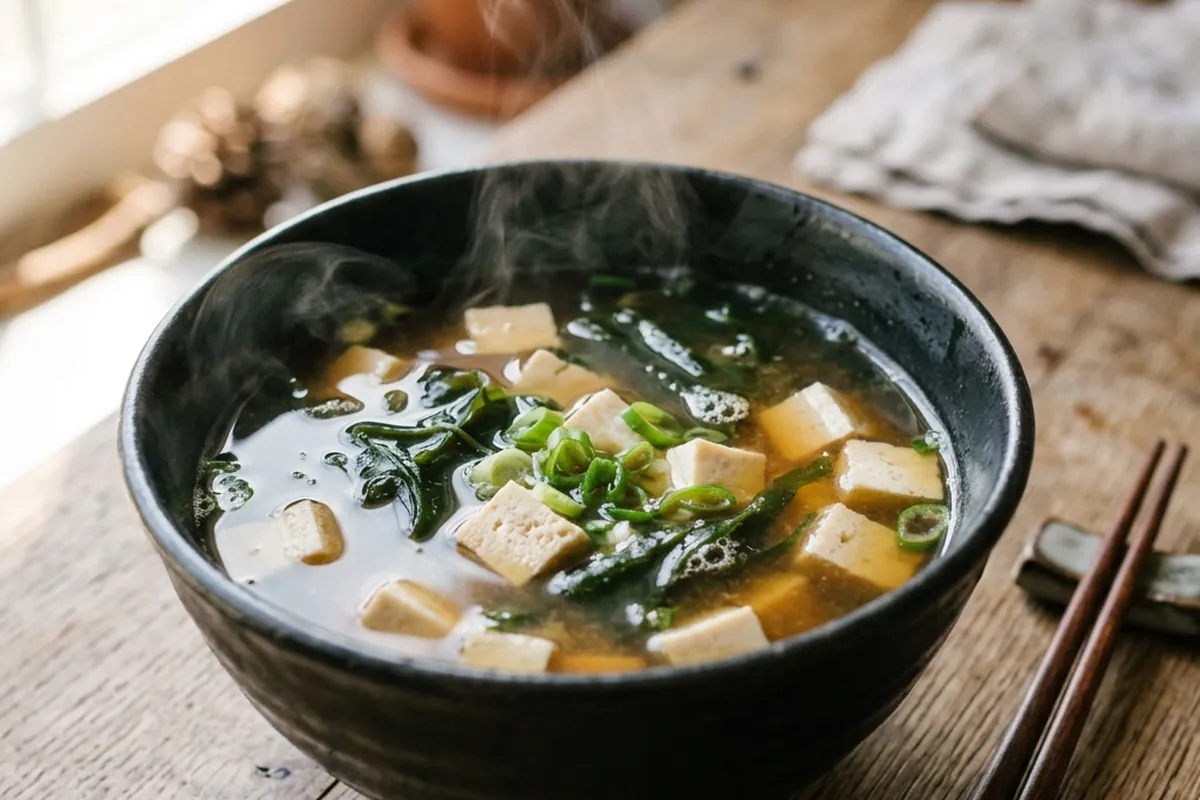
For weight management, miso soup is one of the smartest bowls you can keep on hand, and the reason is simple math. At 35 to 100 calories, a cup gives you warmth, salt, savory satisfaction, and a little protein for almost no calorie cost, which makes it filling out of proportion to what it contains. A bowl 15 minutes before dinner takes the edge off your hunger so you eat less of the heavier main course.
It also fits well into intermittent fasting windows and low-calorie days because it satisfies the urge for something warm and savory without breaking a calorie budget. The honest caveat is the sodium. If you are leaning on miso soup daily, use a low-sodium paste so you are not trading a calorie win for a salt problem. Within that limit, it is hard to think of a more efficient soup for staying full on few calories. The nutrition editors at Bon Appetit make a similar point about brothy, low-calorie soups as appetite managers.
There is more to miso than the calorie count, too. Because it is fermented, miso paste contains beneficial probiotics that support gut health, along with a dose of protein, B vitamins, and minerals like manganese and copper. Whisking it in off the heat rather than boiling it keeps more of those live cultures intact, which is one more reason the technique matters. So a low-calorie bowl is also quietly doing some nutritional work, delivering gut-friendly bacteria and trace nutrients that most light soups cannot claim. That combination, almost no calories paired with real nutritional value, is what sets miso apart from simply drinking warm broth.
Do different types of miso change the calories?
The type of miso you reach for shifts the flavor far more than the calories, but there are small differences worth knowing if you are tracking closely. The three main pastes you will see on a store shelf are white, yellow, and red, and they vary by how long they are fermented and how much rice or barley they contain.
White miso, called shiro miso, is the mildest and sweetest because it is fermented for a shorter time and made with more rice. It runs slightly higher in calories per tablespoon, in the 35 to 40 range, since the extra rice means a touch more carbohydrate. It is also a little lower in sodium than the darker pastes, which makes it my default for an everyday light bowl. Red miso, or aka miso, is fermented longer for a deeper, saltier, more assertive flavor. It is marginally lower in calories per tablespoon but higher in sodium, so a little goes a long way. Yellow miso sits in the middle on both counts, a good all-rounder.
The practical takeaway is that the calorie gap between miso types is small, only a few calories per tablespoon, so choose your paste by the flavor you want rather than the calorie count. If you want a soft, gently sweet bowl, go white. If you want something bold and savory, go red and use a bit less of it to keep the salt in check. Either way, the calorie difference will not move your day.
One more point on paste quality. Some packaged miso products, especially dashi-miso blends sold for convenience, include added sugar, MSG, or extra salt that push both the calories and the sodium up. Reading the label is worth the ten seconds. A plain, single-ingredient miso paste keeps your bowl honest, and you add the dashi flavor yourself.
How to build the lowest-calorie miso bowl
If your goal is the lightest possible bowl that still tastes like real miso soup, the method matters as much as the ingredients. Here is exactly how I make a sub-70-calorie bowl that does not feel like a compromise.
Start with a good dashi base, because that is where the flavor lives for almost no calories. You can make traditional dashi by steeping a piece of kombu seaweed in water and adding bonito flakes off the heat, or use a quality instant dashi powder. A strong dashi means you need less miso paste to get a satisfying bowl, which is the single best way to cut both calories and sodium at once. This is the same principle behind any great soup: a flavorful base lets you lean less on salt and richness.
Next, use exactly one level tablespoon of miso paste per cup of dashi, and always whisk it in off the heat. Boiling miso destroys the live cultures and dulls the flavor, which tempts you to add more paste to compensate, and more paste is more calories and salt. Dissolve the miso in a ladle of warm dashi first, then stir it back into the pot once you have taken it off the burner. This small technique keeps your single tablespoon tasting like two.
Then bulk up the bowl with the near-free ingredients that add volume and nutrition without calories: wakame, sliced scallion, a few thin mushrooms, a little shredded napa cabbage, or fresh spinach wilted in at the end. These fill the bowl, add fiber and minerals, and make it feel like a substantial meal for almost nothing. Add a small amount of silken tofu for protein if you want it to hold you longer. Skip the pork, skip the noodles, and go easy on a second spoon of paste, and you will land a genuinely satisfying bowl right around 60 to 70 calories with plenty of flavor.
Frequently asked questions
How many calories are in a bowl of miso soup?
A standard restaurant bowl of miso soup with tofu and scallions has about 75 to 100 calories. A plain bowl of just dashi and miso paste is even lower, around 35 to 60 calories. Versions with pork or seafood are the exception, climbing to 200 to 250 calories per cup.
Is miso soup low in calories?
Yes, it is one of the lowest-calorie soups you can eat. Most bowls fall between 35 and 100 calories per cup, far below cream-based soups at 250 to 400. The broth contributes almost nothing; nearly all the calories come from the miso paste and any tofu or protein you add.
Why is miso soup so high in sodium?
Miso paste is a fermented, salt-cured soybean product, so the salt is built into the main ingredient. A cup typically carries 600 to 900 milligrams of sodium. You can lower it by using reduced-sodium miso, using a bit less paste, and avoiding salty add-ins, while leaning on dashi and mushrooms for flavor.
Is miso soup good for weight loss?
It can be very helpful. At 35 to 100 calories a cup, it satisfies the craving for something warm and savory for almost no calorie cost, and a bowl before a meal can curb how much you eat afterward. Just choose a low-sodium paste if you drink it often, since the salt is the main downside.
Does adding tofu make miso soup much higher in calories?
Not much. A quarter cup of cubed silken tofu adds only about 20 calories along with a couple grams of protein, so it is one of the best-value add-ins. The ingredients that really raise the count are pork and seafood, which can add 100 to 150 calories per serving.
How many calories are in instant miso soup?
Instant miso soup packets run about 30 to 60 calories per serving, similar to homemade. The catch is sodium, which is often the highest of any version at 800 to 1,200 milligrams per bowl, plus added preservatives. For roughly the same calories, homemade gives you less salt and better ingredients.
Bottom line
Miso soup calories are about as low as soup gets, from 35 calories for a plain bowl to around 100 for the classic tofu-and-scallion version, with the calories driven by the miso paste rather than the broth. That makes it a genuinely smart choice for staying full on few calories, whether as a light lunch or a pre-meal appetite tamer. The one thing to keep an eye on is sodium, not calories, so reach for a low-sodium paste and go easy on salty extras. Do that, and miso soup earns its reputation as one of the lightest, most useful bowls you can keep in your week. Make it at home with a strong dashi and a single spoon of paste, and you get all the warmth and savor for a calorie cost that barely registers.