How much cornstarch to thicken soup depends on how thick you want it, but the working number to memorize is one tablespoon of cornstarch per cup of liquid for a medium, velvety body. Drop to one teaspoon per cup for a light, barely-clinging brothy soup, and go up to two tablespoons per cup for a thick, chowder-like spoon-coater. Cornstarch is about twice as powerful as flour, so a little goes a long way, and the single most important habit is mixing it with cold water into a slurry before it ever touches the hot pot. Get the ratio and the slurry right and you can dial any soup to exactly the texture you want in about two minutes.
This guide gives you the exact amounts for light, medium, and heavy thickening, the slurry method step by step, the temperature science that makes cornstarch work (and what makes it fail), and a troubleshooting list for lumps, a soup that went thin again, and the cloudy or gummy texture that means you overdid it. If you want the wider menu of thickeners beyond cornstarch, my full guide to how to thicken soup with every method that works covers roux, pureeing, reduction, and more; this page is the deep dive on cornstarch specifically.
The Ratios: How Much Cornstarch Per Cup
Cornstarch thickening is all about matching the amount to the body you are after. Here are the working ratios, measured per cup of the liquid you want to thicken.
| Result | Cornstarch per cup of liquid | Good for |
|---|---|---|
| Light body | 1 teaspoon | Brothy vegetable soups, a little cling |
| Medium body | 1 tablespoon | Most soups, a silky, coating texture |
| Heavy body | 2 tablespoons | Chowders, gravy-thick, hearty stews |
These amounts are starting points, not laws. The exact thickening you get also depends on how much liquid has already been thickened by other ingredients, how starchy the soup already is from beans or potatoes, and how acidic it is. A soup that is already a little thick from pureed vegetables needs less cornstarch than a thin, clear broth. Think of the ratios as a calibrated first move that you then fine-tune by eye.
A crucial caveat that trips up a lot of cooks: cornstarch keeps thickening as the soup cools, so aim for a touch thinner on the stove than your final goal. A soup that looks perfect bubbling in the pot can set up too thick by the time it reaches the bowl. When in doubt, start with less. You can always whisk in a second small slurry, but you cannot easily un-thicken a soup short of adding more liquid and reseasoning.
How to Make a Cornstarch Slurry

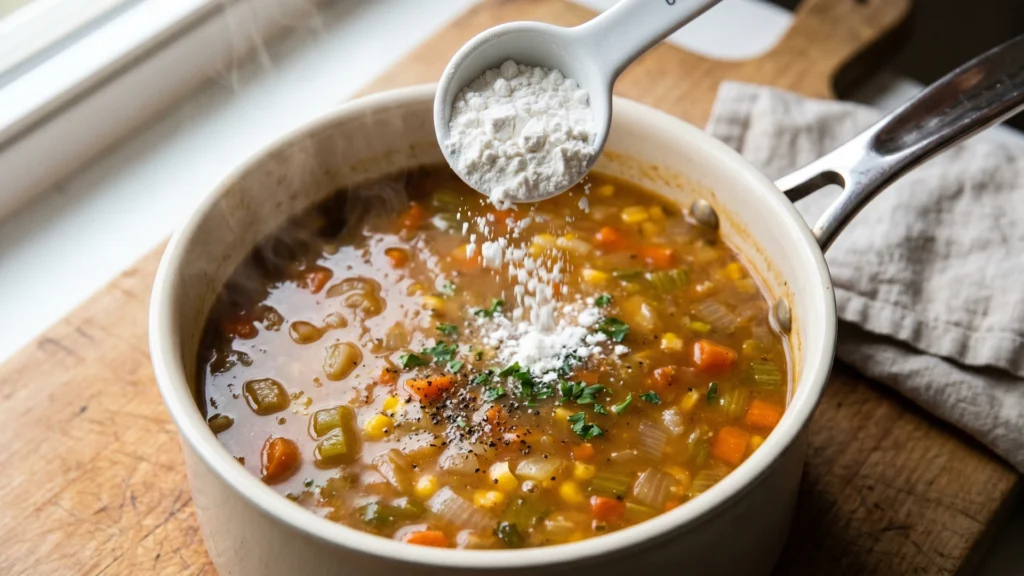
You never add dry cornstarch straight to hot soup. Dropped into hot liquid, the starch granules on the outside swell and gel instantly, sealing off the dry powder inside and forming stubborn lumps you cannot whisk out. The fix is a slurry: cornstarch dissolved in cold liquid first, so every granule is separated and hydrated before it hits the heat.
- Measure the cornstarch for the body you want, using the ratios above.
- Mix with cold water at roughly one part cornstarch to two parts cold water. For one tablespoon of cornstarch, use about two tablespoons of cold water. Cold is essential; warm or hot water starts gelling the starch before you are ready.
- Whisk until completely smooth, with no white sediment at the bottom of the bowl. It should look like thin milk.
- Stir it again right before adding. Cornstarch settles fast, so give it one last whisk so you pour in an even mixture, not water with a paste at the bottom.
You can use a few spoonfuls of cool broth instead of water if you do not want to thin the soup with plain water, but make sure it is not hot. The test cooks at Cook’s Illustrated and other test kitchens describe the same slurry approach because it is simply the most reliable way to get a smooth, lump-free result every time.
When and How to Add the Slurry
Timing and technique matter as much as the ratio. Add the slurry near the end of cooking, once the rest of the soup is built and seasoned. Here is the move:
- Bring the soup to a gentle simmer, not a hard rolling boil.
- Pour the slurry in slowly, in a thin steady stream, while stirring or whisking the soup constantly so it disperses evenly.
- Keep it at a simmer and stir for one to two minutes. You will see and feel it thicken as it heats through.
- Check the consistency, remembering it will set up a little more as it cools, and stop there.
If it is still thinner than you want after a couple of minutes, mix and add a small additional slurry rather than dumping in more dry starch. Patience here is what keeps the texture clean.
One more note on timing: add the slurry after you have finished simmering any vegetables, meat, or pasta, not before. Cornstarch should be one of the last things to go into the pot, because anything that requires long simmering after it goes in risks boiling the gel apart. Build and cook the soup fully, taste and season it, and only then thicken. That ordering keeps you from accidentally undoing your own work.
The Temperature Science: Why It Works and Why It Fails
Cornstarch thickening is a process called gelatinization. As the starch granules heat in liquid, they absorb water and swell, and around the boiling point they burst and release long starch molecules that tangle together and trap water, which is what thickens the soup. This is why a cornstarch-thickened soup needs to reach a near-boil to set up properly; under-heat it and it stays loose and a little raw-tasting.
But there is a flip side, and it is the most common reason a soup mysteriously goes thin again. Prolonged, hard boiling does the opposite of thickening: it shears those long starch molecules apart, breaking the gel and thinning the soup back out. So the rule is to bring it just to the point where it thickens, then ease off. Do not let a cornstarch-thickened soup boil hard for ten more minutes. Acidic ingredients like a heavy hit of lemon, vinegar, or tomato can also weaken cornstarch’s hold, so very acidic soups may need a bit more starch or a more acid-tolerant thickener.
A Worked Example, Start to Finish
It helps to see the whole process on a real pot. Say you have a brothy chicken and vegetable soup, about six cups in the pot, and it tastes great but feels thin and watery, more like a broth than a soup. You want a medium, spoon-coating body.
Start conservatively. Six cups at one tablespoon per cup would be six tablespoons of cornstarch for a full medium thickening, but because you only want to take it from thin to medium, and because cornstarch sets up more as it cools, begin with about three to four tablespoons. Measure that into a small bowl and add roughly twice as much cold water, so six to eight tablespoons, and whisk until it looks like thin white milk with no grit at the bottom.
Bring the soup to a gentle simmer. Give the slurry one final whisk, then pour it into the pot in a thin stream while stirring the soup the whole time. Within a minute or two you will feel the spoon start to drag and see the broth turn glossy and cling to the back of the spoon. Stop there, taste, and let it sit a moment off direct heat. If it is still thinner than you like, mix one more tablespoon of cornstarch with two tablespoons of cold water and repeat. This build-up approach is far safer than guessing high and ending up with a gluey pot.
Cornstarch vs Flour vs Arrowroot
Cornstarch is not the only slurry option, and knowing how it compares helps you pick the right tool.
| Thickener | Power and look | Notes |
|---|---|---|
| Cornstarch | Strong, glossy, fairly clear | Twice the power of flour; breaks with long boiling or strong acid |
| Flour | Milder, opaque, matte | Use about 2 tablespoons per cup; needs longer cooking to lose its raw taste |
| Arrowroot | Strong, very clear, glossy | Good with acidic soups; do not overheat or it turns slimy |
For most clear or brothy soups, cornstarch wins on speed, gloss, and the fact that it does not cloud the color the way a flour slurry can. Flour is better when you want an opaque, creamy, old-fashioned body and have time to cook it. A roux, where flour is cooked in fat first, is the classic route for chowders and gumbos; the editors at America’s Test Kitchen have detailed comparisons of these thickeners if you want to go deeper on the chemistry.
Troubleshooting a Cornstarch-Thickened Soup
When cornstarch goes wrong, it is almost always one of these, and each has a fix.
- Lumps formed: you added dry cornstarch or a slurry made with warm water, or you did not stir while pouring. Strain the lumps out if you can. Next time, use cold water, whisk smooth, and pour in a thin stream while stirring.
- Soup went thin again: you boiled it too long or too hard after it thickened, shearing the starch. Make a fresh small slurry, stir it in, bring just to a simmer, and stop. Strong acid can cause this too.
- Cloudy or pasty texture: too much cornstarch. Thin with more broth and reseason. Going forward, start with less and build up.
- Raw, starchy taste: the soup never got hot enough to fully cook the starch. Bring it to a gentle simmer for a couple of minutes so the cornstarch gelatinizes completely.
- Skin forming on top: normal as it cools. Stir it back in, or keep the surface covered.
Other Ways to Thicken Without Cornstarch

Cornstarch is fast and reliable, but it is worth knowing your alternatives, because sometimes you are out of it, or the soup is highly acidic, or you want to avoid adding any starch at all. Each of these changes the texture in its own way.
- Puree some of the soup: ladle out a cup or two of the cooked vegetables and a little broth, blend until smooth, and stir it back in. This thickens the soup with its own body, adds flavor, and needs no starch at all. It is my favorite method for bean, potato, and vegetable soups.
- Mash beans or potatoes against the side of the pot: a low-tech version of pureeing. The starch from the mashed solids thickens the broth naturally.
- Reduce it: simmer the soup uncovered so water evaporates and everything concentrates. Slow but it intensifies flavor at the same time.
- Stir in a roux: flour cooked in butter, the classic base for chowders and creamy soups. Richer and more opaque than a cornstarch slurry.
- Add a starchy ingredient: a handful of small pasta, rice, or a grated potato cooked into the soup releases starch as it cooks and thickens the broth from the inside.
Cornstarch is the quickest fix when a finished soup is simply too thin, while pureeing and reducing build body more gradually as part of the cooking. For the full rundown of every method and when to reach for each, see the broader guide linked above.
Buying and Measuring Cornstarch
A few practical notes make cornstarch easier to live with. It is cheap, shelf-stable for years if kept dry, and a single box lasts most home cooks a long time. Store it sealed away from moisture, because cornstarch readily clumps if it picks up humidity, and a clumpy box makes a lumpier slurry.
Measure it level, not heaped, since its thickening power is strong enough that a sloppy tablespoon can noticeably overshoot. If you find yourself thickening soups often, it is worth keeping a dedicated small whisk and a little bowl near the stove so making a slurry is a ten-second habit rather than a hunt for tools. And do not confuse cornstarch with cornmeal or corn flour in the American sense; cornstarch is the fine, pure-white powder, while those others are ground corn and behave completely differently.
Storing and Reheating Thickened Soup
Cornstarch-thickened soups store fine, but the texture can shift. As the soup chills, the starch gel firms up, so a soup may look thicker, almost set, in the fridge and then loosen when you reheat it. Warm it gently and stir; if it has thinned too much on reheating, a tiny fresh slurry brings it right back. Avoid boiling it hard during reheating for the same reason you did not boil it hard the first time. For freezing, know that cornstarch-thickened soups can turn a little watery or grainy after thawing as the gel breaks; if you plan to freeze, consider thickening only the portion you are eating now and freezing the rest unthickened, then thickening fresh when you reheat. This is the same batch-cooking logic that keeps a good homemade stock flexible: keep the base neutral and finish each pot to taste.
Frequently Asked Questions
How much cornstarch do I need for a big pot of soup?
Count the cups of liquid and apply the ratio. For a medium body, use one tablespoon of cornstarch per cup. A six-cup pot would take about six tablespoons for medium thickening, but start with a little less, since cornstarch keeps setting as it cools, and add more if needed.
Can I add cornstarch directly to the soup?
No. Dry cornstarch dropped into hot liquid clumps instantly into lumps you cannot whisk out. Always make a slurry first by mixing the cornstarch with cold water until smooth, then stir that into the simmering soup.
Why did my soup get thin again after thickening?
You almost certainly boiled it too hard or too long after adding the cornstarch, which breaks the starch gel. Strong acidic ingredients can do it too. Mix a small fresh slurry, stir it in, bring just to a simmer, and stop heating.
Is cornstarch or flour better for thickening soup?
Cornstarch is about twice as powerful, sets up glossy and clear, and works fast, which suits most brothy soups. Flour gives a softer, opaque, creamy body but needs more of it and longer cooking. Choose based on the look and texture you want.
Will cornstarch make my soup cloudy?
Used correctly, cornstarch stays fairly clear and glossy and keeps the soup’s color. Cloudiness usually means you used too much or did not fully dissolve the slurry. Flour, by contrast, naturally gives a more opaque, matte finish.
Can I use cornstarch to thicken a cold soup?
Not directly, because cornstarch needs heat to thicken. You would have to heat the soup to near-boiling to activate the starch, then chill it. For cold soups, a puree of the soup’s own vegetables or a dairy element is usually a better thickener.
The Bottom Line
The whole skill of thickening soup with cornstarch fits in a few rules. Use one teaspoon per cup for light body, one tablespoon for medium, two tablespoons for heavy, and always mix the cornstarch with cold water into a smooth slurry before it touches the pot. Stir it into a gentle simmer, give it a minute or two to set, and stop before it boils hard, since prolonged boiling thins it back out. Remember that it firms up as it cools, so err on the side of less. Master that and you can take any thin, watery soup and give it a silky, satisfying body in the time it takes to whisk a spoonful of starch into a little cold water.