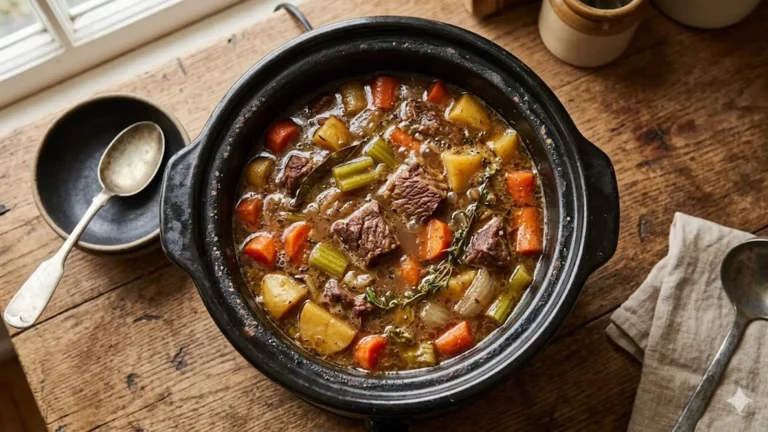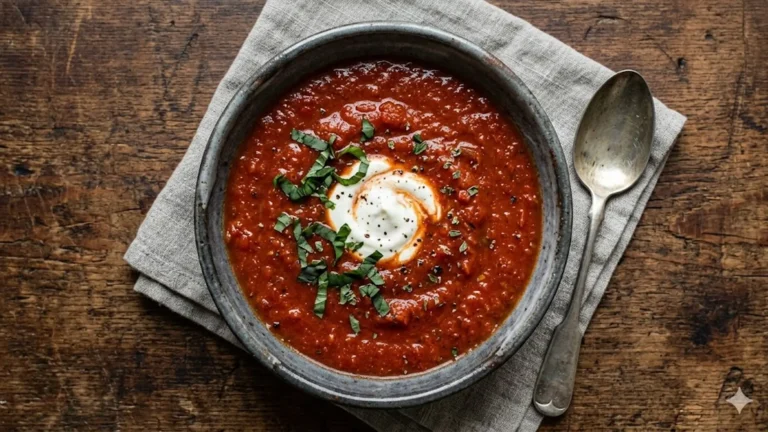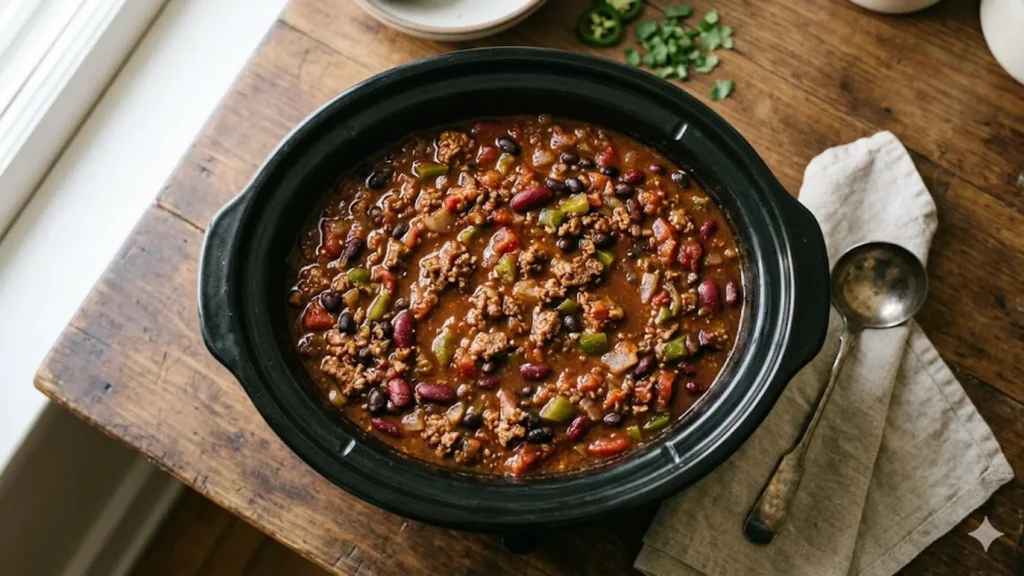
Slow cooker chili is ground meat, beans, tomatoes, and a built spice base left to simmer untouched for hours until the flavors fuse and the meat falls apart. Brown the meat first, layer everything in the crock with less liquid than a stovetop recipe needs, then cook on low 6 to 8 hours or high 3 to 4 hours. The lid traps steam, so a pot that looks thin at the start almost always thickens on its own by hour six.
I have made this dish more Sundays than I can count, and the single thing that separates a great crock of chili from a sad, watery one happens before the cooker is even plugged in. Most recipes online hand you a clock time and a topping list. They skip the part where you actually control texture. That is the part I want to walk you through, because once you understand how a slow cooker behaves, you stop guessing.
Why a slow cooker changes the chili rules
Here is the thing nobody tells you. A stovetop pot loses water to evaporation the whole time it cooks. A covered slow cooker does not. The lid catches steam and drips it right back in, so almost nothing leaves the pot for the entire 6 to 8 hours. If you pour in the same amount of broth a stovetop recipe calls for, you will end up with chili soup.
That single fact rewrites how you build the bowl. I reduce the added liquid by about half a cup compared to any stovetop chili I am adapting. I call it a dry start. You want the crock to look a touch too thick when you assemble it, because the beans and tomatoes will release their own moisture as they break down. By the end it loosens into exactly the right consistency.
The flip side is that low, slow heat is forgiving on tough cuts and cheap ground beef alike. Collagen melts, fat renders slowly, and the spice base has hours to bloom into the liquid instead of sitting on top. This is why even a budget chuck blend turns tender. Time does the work that a hot pan would otherwise rush.
Brown the meat first, and hit the number
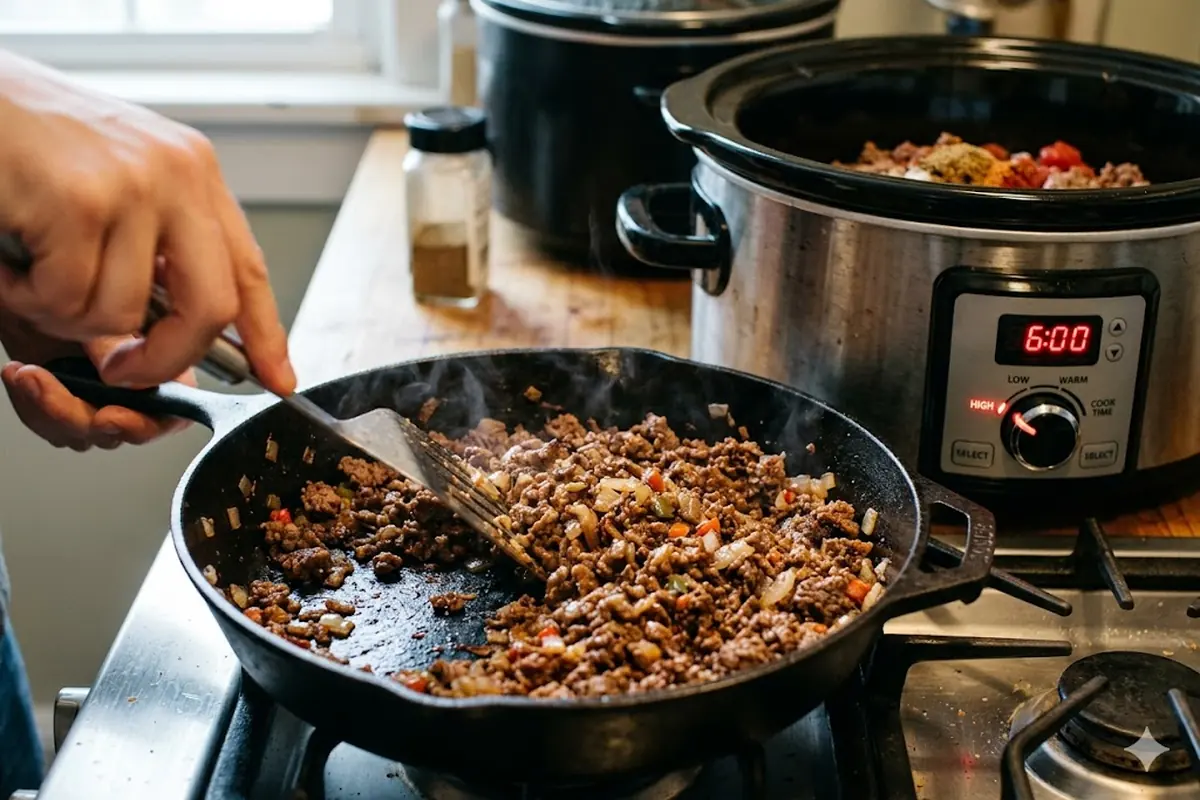
Skip the browning step and you skip the best flavor your chili will ever have. When ground beef hits a hot skillet and the surface dries and darkens, you get the Maillard reaction, the same browning that makes a seared steak taste like more than boiled meat. Raw meat dropped straight into a slow cooker poaches in liquid. It cooks through, but it tastes flat and gray.
Brown one pound of beef over medium-high heat for 6 to 8 minutes, breaking it into crumbles, until it reaches 160 degrees F internal and most of the pink is gone. That temperature matters for food safety with ground meat, and it lets you drain off the rendered grease before it ever enters the crock. A pound of 80/20 beef can shed a quarter cup of fat. Leave it in and your finished chili wears an oily slick.
While the pan is hot, I toss the diced onion and garlic in for two minutes and let the chili powder and cumin bloom in the fat. Toasting dry spices in oil wakes them up. It is a thirty-second move that competitors leave out, and you can taste the difference in the bowl.
Building the spice base that carries the pot
A flat chili almost always means a thin spice base. For a standard pot feeding six, I build with roughly three tablespoons chili powder, one tablespoon cumin, two teaspoons smoked paprika, one teaspoon dried oregano, and a half teaspoon of cocoa powder. The cocoa is not for chocolate flavor. It deepens the meat and rounds the acidity, the same trick a long-simmered mole leans on.
Salt early and salt again at the end. Slow cookers mute seasoning over long cooks because nothing concentrates, so what tasted balanced at hour one reads bland at hour seven. Taste before you serve and adjust. If it needs brightness rather than salt, a splash of vinegar or lime at the very end snaps everything into focus. That late acid hit is what makes people ask what your secret is.
For the spice-curious, the heat ladder is simple. Mild stays at the base above. One diced jalapeno with seeds pushes it to medium. A chopped chipotle in adobo plus its sauce takes it to a smoky, lingering hot without scorching anyone. Add heat at the start so it mellows and integrates rather than stinging on top.
The watery chili fix, with exact ratios
Sometimes you do everything right and the pot still looks loose at the end. Maybe you used very juicy tomatoes, maybe you forgot the dry start. Do not panic and do not just keep cooking with the lid on, because, as we covered, almost no water leaves a closed slow cooker. You have to either let steam out or add a thickener. Here is the decision tree I use.
- If it is only slightly thin: prop the lid open with a wooden spoon and cook on high for 30 to 45 minutes. Now evaporation can actually happen.
- If you want a fast, clean thickening: whisk one tablespoon cornstarch into two tablespoons cold water per cup of excess liquid, stir it in, and cook on high 15 minutes. Cornstarch is flavorless and reliable.
- If you want flavor along with body: stir in two tablespoons masa harina per cup of thin liquid. Masa is the corn flour behind tamales, and it thickens while adding a toasty backbone that suits chili perfectly.
- If you are out of both: two tablespoons of tomato paste tightens the pot and boosts the savory depth at the same time.
The opposite problem, chili that is too thick or pasty, fixes with a quarter cup of warm broth stirred in at a time until it loosens. Go slow. You can always add more, but you cannot pull it back out.
One caution on cornstarch. It loses its thickening power if you boil it hard for too long, so stir the slurry in near the end and give it just 15 minutes on high. Masa is more forgiving and can sit longer without thinning back out, which is why I reach for it when I have the time. Flour works in a pinch but needs to cook at least 20 minutes to shed its raw, pasty taste, so I rank it last of the three. Whichever you pick, add it gradually and judge the body by how it coats the back of a spoon rather than by eye alone.
Beans, and choosing the right one
Bean choice is more than tradition. It changes how the pot holds up over a long cook. Kidney beans are the classic because their thick skins survive 8 hours without collapsing into mush. Black beans hold shape too and lend a deeper color. Pinto beans go soft and creamy, which some people love and others find too broken down by hour seven.
Rinse and drain canned beans before they go in. The starchy can liquid is salty and can turn the whole pot cloudy. Add beans at the start for a standard cook, but if you like them more intact, hold them back and stir them in during the last hour. For a deeper look at building flavor from scratch, my guide on how to make soup stock covers the same principle of layering ingredients by cook time, and the lessons carry straight over to chili.
A bowl that went wrong, and what it taught me
The first time I made slow cooker chili for a crowd, I treated it like my stovetop recipe and dumped in two full cups of broth on top of a can of crushed tomatoes. Eight hours later I lifted the lid to a thin, sloshing red soup with meat floating in it. I had a porch full of people and no time to reduce it properly.
I stirred in three tablespoons of masa harina, cranked it to high, and propped the lid with a spoon. Forty minutes later it had pulled together into a thick, spoon-coating chili that nobody suspected had nearly been broth. That rescue is exactly why I now start every slow cooker chili dry and thicken only if I have to. The mistake taught me more than any recipe ever did.
If you cook for people with dietary needs, chili adapts easily. My gluten free soup notes apply here too, since the only common gluten risk in chili is a seasoning packet or a thickener, both easy to swap. And if low-carb is the goal, the bean-free approach in my white chicken chili keto bowl shows how to keep body without the legumes.
Slow cooker size, fill level, and why it matters
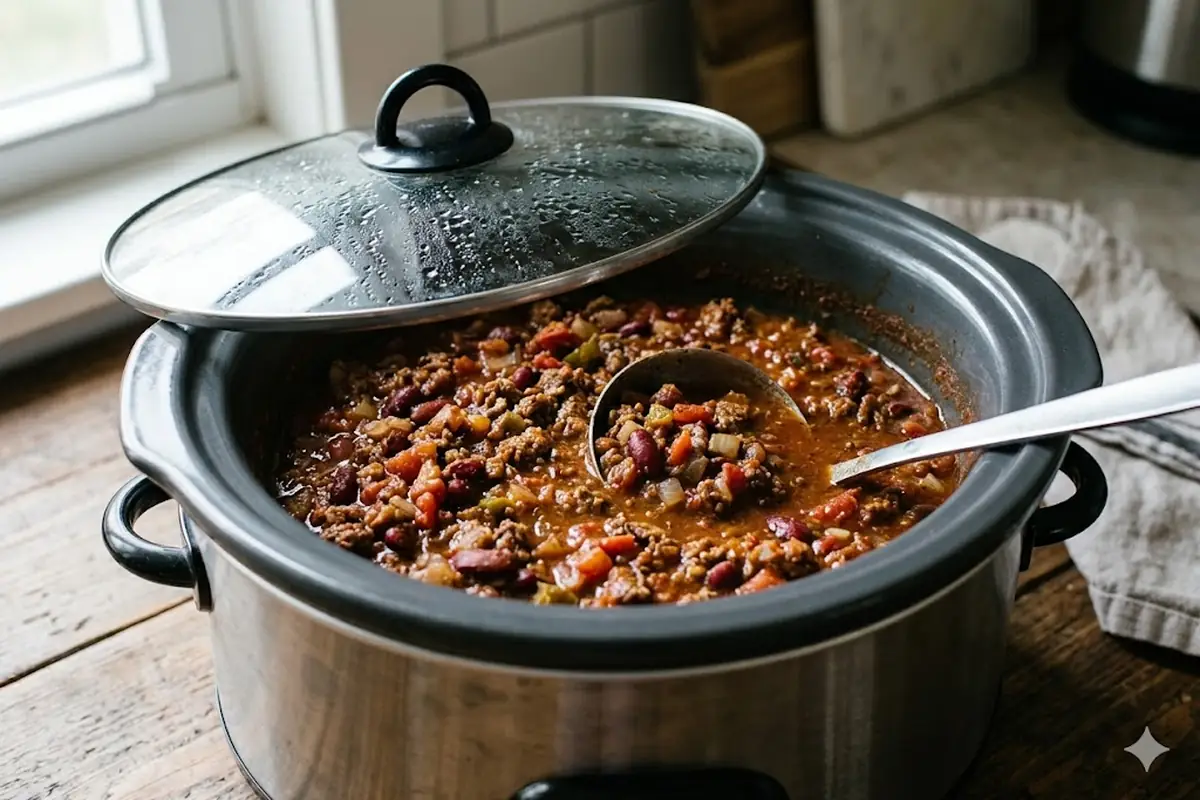
The size of your cooker quietly decides how your chili turns out. A slow cooker is engineered to work best when it sits between half and three-quarters full. Below the halfway mark, the contents heat too fast and the edges scorch. Packed to the rim, the center never gets hot enough and the cook stretches unpredictably. For a standard six-serving pot I reach for a 6-quart cooker, which lands in that sweet spot.
If you are doubling the recipe, do not just cram everything into the same crock and hope. An overfilled cooker can sit below a safe temperature for hours, which is a real food-safety concern with meat. Either step up to a 7 or 8-quart model or split the batch across two cookers. I learned this the hard way when a double batch in one pot came out lukewarm in the middle after the full 8 hours.
One more habit. Resist the urge to lift the lid and stir. Every peek drops the internal temperature and adds roughly 20 to 30 minutes to your cook time as the cooker climbs back up. The whole point of this method is to leave it alone. Stir once at the start, season at the end, and let the machine do its job in between.
Meat options beyond ground beef
Ground beef is the default, but it is far from the only good choice. Ground turkey makes a lighter pot and takes spice well, though it needs a touch more salt and fat to keep from tasting lean. A pound of cubed chuck roast, browned hard on all sides, turns into shreddable, tender chunks over a long cook and gives you a steakhouse-style chili with real bite.
For a meatless pot, double the beans and add a cup of cooked lentils or a diced sweet potato for body. Mushrooms, browned until they give up their water and darken, bring a savory, almost meaty depth that vegetarians and skeptics both notice. The browning rule still applies. Whatever protein or vegetable you anchor the pot with, take the time to develop color on it in the pan first. That is where the flavor lives.
Toppings and what to serve alongside
Toppings are not decoration. They add the contrast a long-cooked pot loses. Cold sour cream against hot chili, sharp raw onion against deep spice, crunchy tortilla strips against soft beans. I always set out shredded cheddar, diced white onion, sliced jalapeno, cilantro, and lime wedges so everyone tunes their own bowl.
For sides, cornbread is the obvious partner because it soaks up the liquid. Rice stretches the pot to feed more people. A simple slaw cuts the richness. America’s Test Kitchen has a useful breakdown of chili-building technique if you want to go deeper on the science of balancing fat, acid, and heat. For a heartier carb plate, a bowl of chicken pasta from Pastapeak rounds out a casual chili night when you are feeding a hungry group.
Make ahead, storage, and reheating
Chili is one of those rare dishes that tastes better the next day, because the spices keep marrying overnight in the fridge. Cool it within two hours of cooking, then refrigerate up to 4 days in a sealed container. It freezes beautifully for up to 3 months. I freeze it flat in zip bags so it stacks and thaws fast.
Reheat gently. A hard boil can split the fat and turn the texture greasy. Warm it over medium-low on the stove, or microwave in bursts, stirring between, until it reaches 165 degrees F throughout. If it thickened too much in the fridge, loosen with a splash of broth as it heats. Bon Appetit has a thorough piece on batch-cooking and reheating if you want more on keeping leftovers safe.
Frequently asked questions
Do I really have to brown the meat for slow cooker chili?
You do not have to, but you should. Browning builds the Maillard flavor that raw meat poached in liquid never develops, and it lets you drain the grease. Skipping it gives you safe but flat, gray-tasting chili. The extra 8 minutes pays off in every bowl.
How long does slow cooker chili take to cook?
Plan on 6 to 8 hours on low or 3 to 4 hours on high. Low and slow gives the most tender meat and the deepest melded flavor. The chili is technically done once everything is hot and the meat is cooked, but the texture and taste keep improving the longer it goes.
Why is my slow cooker chili watery?
Because a covered slow cooker barely evaporates any liquid, so you started with too much. Fix it by propping the lid open on high for 30 to 45 minutes, or stir in a cornstarch slurry (1 tablespoon per cup of excess liquid) or 2 tablespoons of masa harina to thicken fast.
Can I put raw beef straight into the slow cooker?
You can, and it will cook through safely to a food-safe temperature over the long cook. But the flavor and texture suffer, and you cannot drain the fat, so the finished chili turns oily. Browning to 160 degrees F first solves both problems.
Should I add beans at the start or the end?
Add canned beans at the start for a standard cook and they will hold up fine if you use kidney or black beans. If you want them more intact and less broken down, stir them in during the final hour instead. Always rinse and drain them first.
Can I make this chili ahead of time?
Yes, and it is better for it. Chili deepens overnight as the spices keep blending. Refrigerate up to 4 days or freeze up to 3 months. Reheat gently to 165 degrees F and loosen with a splash of broth if it tightened in the cold.
How do I add more heat without ruining it for everyone?
Keep the base mild and let people add heat at the table with sliced jalapenos or hot sauce. If you want the whole pot hotter, stir in one diced jalapeno or a chopped chipotle in adobo at the start so the heat mellows and integrates rather than stinging on top.